9 Best Advertising Management Software for B2B in 2026


No advertising management software platform has everything.
Some have exclusive access to specific channels, others have deep targeting capabilities, and others integrate better with your marketing tech stack.
In this post, our aim is to give you an honest comparison of eight of the leading advertising management software tools, so you can choose the one that best fits your GTM strategy.
Key takeaways:
- No single advertising management platform does everything — the right choice for B2B depends on targeting precision: contact-level (Influ2), account-level (AdRoll ABM, 6sense, Demandbase), or audience-level (Google, Meta, LinkedIn).
- Look for platforms that connect ad engagement to pipeline and revenue, not just CTR and impressions.
- Contact-level advertising is the only approach that guarantees ads reach named buying group members, not just anyone at a target company.
What is advertising management software?
Advertising management software is a platform that lets marketing teams plan, execute, target, and measure paid ad campaigns, usually across multiple channels, from a single interface.
For B2B teams, the most important variable is targeting precision. Most general-purpose advertising software targets at the audience level: demographics, interests, and behaviors. ABM-focused ad management platforms go further, either at the account level (anyone at a specific company) or the contact level (named individuals synced directly from your CRM).
The best B2B advertising management platforms handle three things:
- Campaign execution: build and launch ads across multiple ad networks from one interface
- B2B-specific targeting: reach named accounts, buying group members, or intent-based segments
- Revenue attribution: connect ad engagement to pipeline and closed-won deals, not just clicks
The tools on this list range from ABM-native platforms built specifically for B2B revenue teams to general-purpose ad management software that B2B teams adapt to fit their use case.
Advertising management software comparison table
| Software | Available channels | Targeting Capabilities | Best for |
| Influ2 | Meta, LinkedIn, Google Display, Bing, Amazon | Contact-level | B2B teams running contact-level ABM ad programs |
| Taboola | Publisher websites, video inventory, Taboola Feed | Audience-level (contextual/behavioral) | Content discovery and native ad plays across publisher sites |
| AdRoll | LinkedIn, Facebook, Instagram, Google, AppNexus, AOL, Yahoo, Taboola | Account-level (with some contact-level) | B2B teams building account-based ad motions |
| 6sense | 6sense DSP, LinkedIn, Facebook, Instagram | Account-level | B2B teams that want AI-driven intent to guide ad targeting |
| Demandbase | Display ads, native ads, video, connected TV, LinkedIn, Facebook, Twitter, Instagram | Account-level | Enterprise ABM teams with complex tech stacks |
| Google Ads | Search, Display Network, YouTube, Gmail, Discover, Google Play | Audience-level (keyword, custom segments) | Capturing in-market demand via search intent |
| Meta Ads Manager | Facebook, Instagram, Messenger, Audience Network, WhatsApp (limited) | Audience-level (profile-based) | Prospecting and lookalike audiences at scale |
| LinkedIn Campaign Manager | LinkedIn feed, messaging, video, events, InMail | Account-level and contact-level | B2B brands with higher LTVs needing precise professional targeting |
1. Influ2
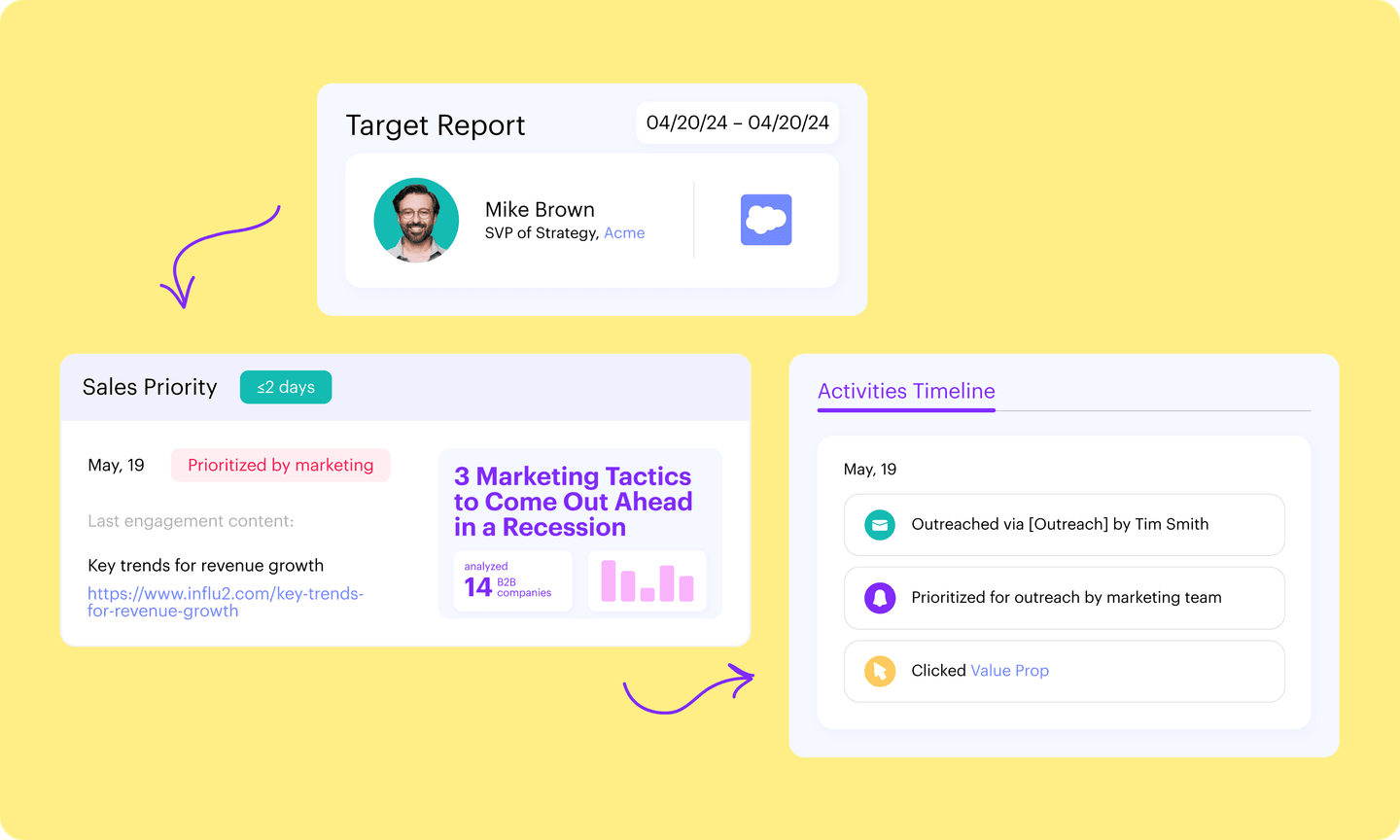
Influ2 isn't specifically an advertising management solution. It's contact-level ABM with contact-level advertising capabilities that let you:
- Show ads to named buyers across multiple ad networks
- Generate contact-level intent signals that help salespeople understand who to call and what to say
- Tailor ads for each buyer’s unique journey
- Understand how programs helped sell more (marketing’s full revenue influence)
With Influ2, you can target the same contacts Sales is going after (pulled straight from your CRM) and show them ads that reflect where they are in the sales process.
Available channels
Influ2 delivers contact-level ads across a wide range of ad networks, including:
- Meta (Facebook and Instagram)
- Google Display
- Bing
- Taboola
- Amazon
Targeting capabilities
Most ad platforms only allow targeting at the account level, where you show ads to anyone within a target account (regardless of whether they have purchasing power or are even in the right department).
Influ2 allows you to specify the exact buying group members you include in your campaign by syncing with your CRM to build your ad audience.
Reporting and attribution
Influ2’s revenue reporting allows you to track the impact of ad programs on sales pipeline.
Yes, you can track engagement data like clicks and views, but you can also tie that ad engagement directly to revenue by examining how your ad programs impact core goals like pipeline generation or deals won.
Learn more about how we measure marketing-influenced revenue.
Integrations
- Marketo
- Salesforce
- Hubspot
- Eloqua
- Dynamics 365
- Outreach
- Salesloft
- Slack
- Microsoft Teams
2. Rollworks
Rollworks is an account-based marketing platform, but unlike many ABM platforms that focus on buying signals and identifying target accounts, Rollworks is built for B2B teams running an ad-based ABM motion.
It has its own demand-side platform (a specialized software tool for automatically buying and placing ads across multiple networks), which gives you access to over 2 million publishers.
Rollworks also has fairly strong B2B targeting capabilities. You can upload a contact list from your CRM, and the platform will seek to match email addresses against web browser cookies, so you can show ads to target buyers.
You can also use Rollworks’ firmographic, buying intent, and site engagement data to identify which companies are likely to be in-market and add them to your target account list.
Available channels
You can deliver ads across LinkedIn, Facebook, and Instagram, as well as on exchanges such as Google, AppNexus, AOL, Yahoo, and Taboola.
Targeting capabilities
- Account-level targeting based on firmographic and intent data
- Behavioral targeting
- Geo-targeting
- Retargeting
- Lookalike modeling
Reporting and attribution
- Measure the impact of your ad programs on revenue generation
- Track the influence of multiple Sales and Marketing touchpoints on won deals (multi-touch ABM attribution)
Integrations
- Salesforce
- HubSpot
- Marketo
- Oracle Eloqua
- LinkedIn Ads
- Facebook Ads
- Google Analytics
- Google Tag Manager
- Slack
- Zapier
3. 6sense
6sense is designed to help account-based marketing teams identify target accounts and pursue them across multiple channels (e.g., ads, email, and social media messaging).
Advertising isn’t really 6sense’s flagship feature, though they do offer a few solid features for teams that want to integrate ads into a broader multichannel program. For instance, they have their own demand-side platform (DSP) and integrations with Meta, Google, and LinkedIn.
The big selling point, however, is 6sense’s targeting capabilities.
6sense integrates intent data from multiple sources, including how prospects search on Google, consume content, or interact with competitors’ ads. It then uses AI to help you prioritize accounts based on their buying stage and how likely they are to convert.
If you want to get really hands-off, you can use 6sense’s predictive AI and Dynamic Segmentation feature, which automatically updates ad audiences based on behavior, moving prospects into different segments as they progress through the sales journey.
Available channels
- Display advertising via 6sense's DSP
Targeting capabilities
- Account-level targeting using firmographic and intent data
- Behavioral targeting
- Geo-targeting
- Retargeting
- Lookalike modeling
Reporting and attribution
- Report on basic ad engagement data like clicks and impressions
- Track (estimate) which buying stage each account is in
- Monitor how ad spend impacts revenue generation (and how it compares to other channels)
Integrations
- Salesforce
- HubSpot
- Marketo
- Oracle Eloqua
- LinkedIn Ads
- Facebook Ads
- Google Ads
- Slack
- Zapier
- Google Tag Manager
4. Demandbase
Demandbase has a fairly similar offering to 6sense—it's an ABM tool for B2B Sales and Marketing teams.
But where 6sense integrates the intent layer to help guess which companies are about to buy and shows them ads before they raise their hand, Demandbase takes a more traditional approach.
In the Campaign Builder, you can select a desired campaign outcome, import a target account list, and use role-based targeting to reach people who are likely to be in the buying group.
They have an AI layer as well (e.g., automated bidding strategies), but it’s not as sophisticated as 6sense’s.
Demandbase has its own B2B DSP too, but its targeting is still based on job level and role, so it's still a bit of a black box. You can’t specify individual contacts to target, only people who have a particular job title.
Where Demandbase does stand out, though, is in its firmographic and technographic targeting filters, which allow you to get super granular—great if you have a really tightly defined ICP. You can also set up campaigns where your ad content dynamically changes based on company attributes (like the company’s name) to add a touch of simple personalization.
Available channels
- Display ads across web properties via Demandbase's DSP
- Native advertising placements
- Video advertising campaigns
- Connected TV advertising
- Social media platforms: LinkedIn, Facebook, Twitter, Instagram
Targeting capabilities
- Account-level targeting
- Behavioral targeting
- Geo-targeting
- Retargeting
- Lookalike modeling
Reporting and attribution
- Track account-level performance (which companies saw your ads, clicked them, or visited your site)
- See how ad engagement influences pipeline
- Compare performance across different segments (e.g., industries or geos)
Integrations
- Salesforce
- HubSpot
- Marketo
- Oracle Eloqua
- Microsoft Dynamics
- Google Analytics
- Adobe Analytics
- LinkedIn Ads
- Facebook Ads
- Slack
- Zapier
5. Taboola
Taboola takes a slightly different approach to advertising than most ad management platforms.
Instead of placing ads in display banners or search results, Taboola offers native ad placements across publisher websites. Your ads appear as part of the editorial content readers are consuming.
For example, if you’ve identified that your target audience regularly visits CBS News, you could run a banner ad on the site, like this one from Cvent:

Or, using Taboola, you could have your ad appear as if it were native news content from CBS, the benefit here being that you can leverage some of the trust readers have in CBS’s brand and hopefully improve your click-through rate.
Obviously, there has to be some transparency here, so readers will still see the Taboola logo or a note like “Promoted Links by Taboola” next to the ad content to distinguish it from real native content.
Available channels
Taboola offers ad space for both mobile and desktop devices across three main channels:
- Publisher websites (e.g., USA Today, NBC News, and Bloomberg) via Taboola’s native ad placements
- Video inventory (in-feed and outstream formats)
- Taboola Feed (content recommendation widgets embedded on publisher pages)
Targeting capabilities
- Contextual targeting (matches ads to relevant content on publisher sites)
- Behavioral targeting (based on user browsing and engagement patterns)
- Geo-targeting
- Retargeting
- Lookalike audiences
Reporting and attribution
- Track when prospects view and click your ads, and when they take a specific action you deem as a “conversion,” such as filling out a form
- Compare campaign effectiveness side-by-side and break down results by audience, creative, and placement
Integrations
- Google Analytics
- Adobe Analytics
- Google Tag Manager
- Salesforce
- HubSpot
- Shopify
- Magento
- Segment
- Tealium
- Oracle Eloqua
6. Google Ads
Google Ads combines three big networks (Google Search, YouTube, and Google’s Display Network) into one ad management platform, giving you a huge reach compared to other native ad platforms.
The most unique aspect of Google Ads is its Search offering.
When someone searches for something on Google, they’re giving you an insight into their intent (the thing they searched for).
This means that when you bid on that search term and run ads against it, you can get super granular (and relevant) with your messaging—great for capturing existing demand (though harder for demand creation).
Available channels
- Google Search (text ads)
- Google Display Network (banner/display ads on partner sites)
- YouTube (video ads)
- Google Shopping (product listings)
- Gmail (sponsored placements in inbox)
- Google Discover feed (Discovery ads)
- Google Play (app promotion)
Targeting capabilities
- Keyword targeting
- Custom segments (based on interest or intent)
- Demographic and location targeting
- Remarketing
- Customer match (you have to upload first-party contact data)
- Lookalike audiences
Reporting and attribution
- Track basic engagement metrics like CTR
- Break engagement down by device, geo, ad group, keyword, and audience segment
- Set up custom multi-touch attribution models
- Find out what users typed into Google before clicking your search ad
Integrations
- Google Analytics
- Google Tag Manager
- Google Merchant Center
- Google Marketing Platform
- Salesforce
- HubSpot
- Looker Studio
- Zapier
7. Meta Ads Manager
Meta Ads Manager is the official platform for managing Facebook, Instagram, Messenger, and WhatsApp ads.
It has a really strong lookalike audience feature, which is more of a B2C-facing tool but can be used in a B2B context as a form of prospecting tool (you run ads to a lookalike audience and measure engagement, find new accounts that show some intent).
Meta Ads Manager’s big downfall is that it doesn’t have native account-level targeting, since it's built more for the B2C market.
Enterprise revenue teams advertising directly on Meta will need to implement strategic workarounds for this to work, such as uploading contact lists manually or using IP reveal tools to build custom lookalike audiences.
Available channels
- Facebook (Feed, Stories, Marketplace, Reels, etc.)
- Instagram (Feed, Stories, Explore, Reels)
- Messenger
- Audience Network (ads on third-party mobile apps and websites)
- WhatsApp (limited ad formats and objectives)
Targeting capabilities
- Core audience targeting (age, gender, interests, behaviors, location)
- Custom audiences from first-party data
- Website/app activity retargeting
- Lookalike audiences
Reporting and attribution
- Install Meta Pixel to track actions like purchases and form fills resulting from ad clicks
- Track journeys across devices (like someone clicking on an ad on mobile but buying on a laptop)
- See performance by device type, region, age, gender, or campaign structure
Integrations
- Meta Pixel
- Meta Conversions API
- Salesforce
- HubSpot
- Shopify
- Zapier
- Google Analytics (via UTMs)
- Marketo (via third-party connectors)
8. LinkedIn Campaign Manager
Campaign Manager is the ad management toolkit for advertising directly on LinkedIn, allowing B2B Marketing teams to get in front of specific buyers in their feed or even directly in their inbox.
It has very accurate account-level targeting, since you’re only advertising to people who say they work for the target company on their LinkedIn profile, and more detailed professional filters (role, seniority, company size) than any other platform.
The big downside with LinkedIn Campaign Manager is that CPCs and CPMs are typically much higher than Meta or Google, making it a better fit for companies with higher LTVs (customer lifetime value) who can sustain a bigger CAC (customer acquisition cost).
Available channels
- LinkedIn Feed (show as sponsored content)
- LinkedIn Messaging (message ads and conversation ads)
- Right rail and top banner ads (available on desktop only)
- In-feed video ads
- LinkedIn Audience Network (though they offer limited third-party inventory)
- LinkedIn Events (sponsored event ads)
Targeting capabilities
- Account-level targeting (via company name, size, industry, etc.)
- Contact-level targeting (by uploading a list of email addresses)
- Job title, function, seniority, and skills targeting
- Company growth, revenue, and tech stack filters
- Website retargeting
- Lookalike audiences via matched audiences
Reporting and attribution
- Track impressions, clicks, CTR, spend, video views, leads generated, and engagement rate
- Break performance down by demographics like company, title, and industry
- View ad performance by target company name (if you’re using Matched Account Lists)
Integrations
- Salesforce
- HubSpot
- Marketo
- Oracle Eloqua
- Zapier
- LinkedIn Insight Tag
- Google Analytics (via UTMs)
9. Marpipe
Marpipe is a creative automation and feed management platform that transforms product catalogs into high-performing advertising assets. While many ad management tools focus on budget and targeting, Marpipe focuses on the creative itself—enabling e-commerce brands to gain 100% control over their Dynamic Product Ads (DPA) and see an average of 20% lift in performance.
Available channels
- Meta (Facebook & Instagram)
- Google (Performance Max)
- Snapchat, Pinterest, X, and Reddit
- Axon (TikTok-style short-form video)
Reporting and attribution
- Track CTR, ROAS, and incremental lift metrics in real time
- Visualize "plain vs. enriched" catalog performance side-by-side
- See directly how creative enhancements contribute to campaign success and revenue influence
Integrations
- Shopify
- Salesforce
- BigCommerce
- WooCommerce
How to choose advertising management software for B2B
Before settling on a B2B advertising management platform, four variables determine which option is the right fit.
Targeting precision
Account-level targeting reaches anyone at a specific company. Contact-level targeting reaches named individuals from your CRM.
Audience-level targeting reaches demographic or behavioral segments. For most B2B teams with a defined ICP (ideal customer profile) and a named target account list, account-level is the minimum. If you're running ABM programs with a specific buying group in mind, contact-level is where the real precision lives.
Channel coverage
Some buyers are on LinkedIn. Some are on industry publisher sites. Some are searching Google for your category. Most are in all three places at different times.
Look for a platform that covers the channels where your buyers actually spend time, not just the channels highlighted in the vendor's sales deck.
CRM and MAP integration
The most important integration for a B2B ad platform is your CRM. If you can't sync your contact list into the platform and target those specific people, you're back to audience-level targeting regardless of what the platform claims.
Check which CRM and MAP (marketing automation platform) integrations exist and how the sync works before committing.
Attribution model
Most ad platforms default to last-click attribution. For B2B with long sales cycles and multiple stakeholders, that understates the contribution of every touchpoint that wasn't the last one.
Look for platforms that support multi-touch attribution, or better yet, platforms that track revenue influence, like Influ2's Revenue Reporting.
Frequently asked questions
What is advertising management software?
Advertising management software is a platform that lets teams plan, execute, target, and measure paid ad campaigns across multiple channels from a single interface. For B2B teams, the most important considerations are targeting precision (account-level vs. contact-level), CRM integration, and whether the platform supports revenue attribution beyond clicks.
What is the best advertising management software for B2B?
The best ad management software for B2B depends on targeting needs. Influ2 is purpose-built for contact-level targeting, delivering ads to named individuals from your CRM across six networks. AdRoll ABM and 6sense are strong choices for account-level ABM ad programs. LinkedIn Campaign Manager is the go-to for professional audience precision. Google Ads is the standard for capturing search-driven demand.
What is the difference between account-level and contact-level advertising?
Account-level advertising delivers ads to anyone at a target company. Contact-level advertising delivers ads to named individuals from a specific list, typically synced from your CRM. The difference matters because account-level targeting can reach thousands of people at a company who have no role in the buying decision. Contact-level targeting reaches only the people who do.
What's the best tool for managing ads across multiple networks?
For B2B teams, Influ2 delivers contact-level ads across Meta, LinkedIn, Google Display, Bing, Taboola, and Amazon from a single platform. AdRoll ABM also supports multi-network delivery across LinkedIn, Facebook, Instagram, and several ad exchanges. For broad cross-network management including search, Google Ads covers the widest channel footprint.
How do you measure ROI on B2B ad campaigns?
The most accurate way to measure B2B ad ROI is to connect ad engagement to pipeline and closed-won revenue, not just clicks and impressions. Platforms like Influ2 have built-in revenue reporting that ties ad programs to pipeline generated and deals influenced. For platforms that don't support this natively, you'll need to integrate with your CRM and build attribution models in your BI tool.

Dominique Jackson is a Content Marketer Manager at Influ2. Over the past 10 years, he has worked with startups and enterprise B2B SaaS companies to boost pipeline and revenue through strategic content initiatives.
