The B2B Buyer’s Journey Isn’t Linear (Here’s How to Adapt)


Google “B2B buyer journey” and you’ll see a bunch of frameworks that show a linear progression. It’s usually some variation of awareness, consideration, and decision, with one buyer moving cleanly from step to step.
But the reality of B2B buyer journeys is messier, longer, and driven by a cast of a dozen or more people whose priorities rarely align on the same timeline. Building your GTM strategy around the linear model is where the expensive mistakes get made.
Dreamdata's 2025 B2B go-to-market benchmarks found the average B2B customer journey spans 211 days and 76 touchpoints, across a buying committee that now averages 5+ stakeholders.
That's a buying ecosystem, not a funnel, and your strategy needs to match that reality.
What is the B2B buyer's journey?
The B2B buyer's journey is the end-to-end process a person goes through when identifying a problem, evaluating solutions, making a purchase decision, and the post-purchase phase.
That sounds great because it lets you simplify a process that’s actually a lot messier. But it causes marketers to build their GTM strategy around the assumption that B2B buyers follow a path that looks something like this:
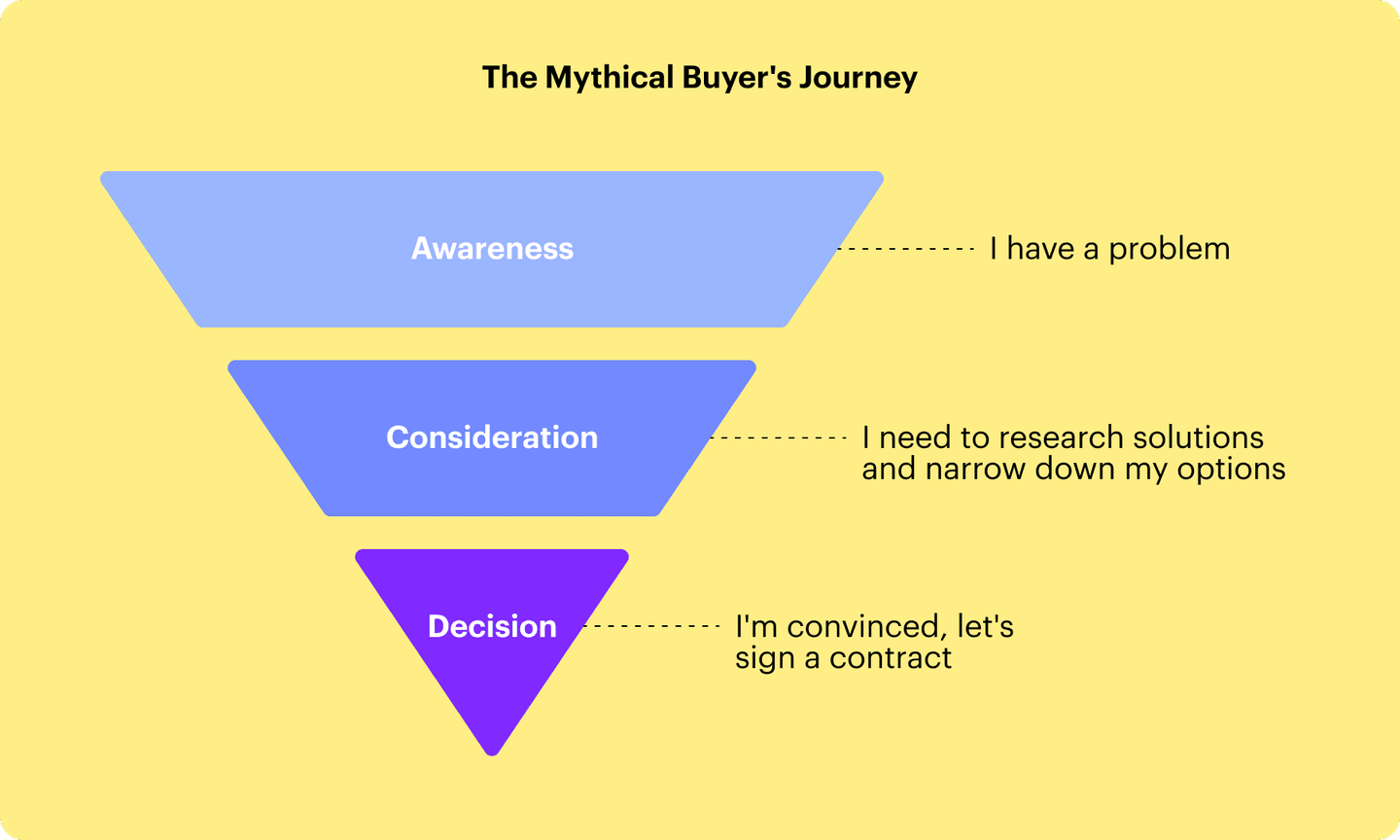
Awareness (recognizing the problem)
Sam, a Chief Marketing Officer, realizes his team spends three days pulling reports from six different tools to complete monthly reporting.
There's got to be a way to use fewer tools, speed up reporting, and gain a more complete picture of performance, right?
Consideration (researching solutions)
Sam starts researching marketing platforms to see what's out there and compare features against his existing tech stack. He asks his network on LinkedIn and checks out reviews on G2.
He's narrowed down his options.
Decision (choosing a vendor)
Sam signs up for a product demo with a sales rep. He's sold by their pitch and makes the budget request to his boss.
Budget in hand, Sam signs on the dotted line.
Post-Purchase (upgrading and renewing)
Sam and his team fly through implementation and love the product. Over time, they expand their plan.
Sounds great. Sam's buying journey was predictable, linear, and quick.
But you and I both know that’s not how it goes.
The B2B buying journey is rife with indecision, too many stakeholders, budget chokeholds, and intense competition. It's anything but simple and linear.
What B2B buyer journeys really look like
Your GTM strategy needs to reflect buyers' reality, meet them at key moments, and influence their decisions.
So let's look at what Sam's buying journey actually looked like:
- Reporting's taking forever; too many tools are creating data silos. Sam has a problem. But he's busy and has to finish up reporting and prep for the board.
- Later, he sees a peer on LinkedIn talking about solving this same problem. They chat, and Sam checks out the website his friend recommends.
- Sam's excited. The tool looks like it could really help his team. He signs up for a free trial.
- Sam attends a conference for a few days; reporting issues forgotten.
- After the conference, Sam's playing catch up. His free trial expires, but he's focused elsewhere.
- Weeks later, he sees an ad for that product. He revisits the website and sends it over to his boss on Teams. His boss says, "looks cool, but not a lot of budget room 'til next quarter."
And so it goes.
Sam's journey is unwieldy; his urgency ebbs and flows with dozens of variables competing for his time.
He'll inch forward, then double back to answer questions, gather proof points, or understand competitive options. He'll have to make the case to his boss and sell internal team members on this new purchase.
Far from a straight line, Sam’s journey looks a lot more like this:
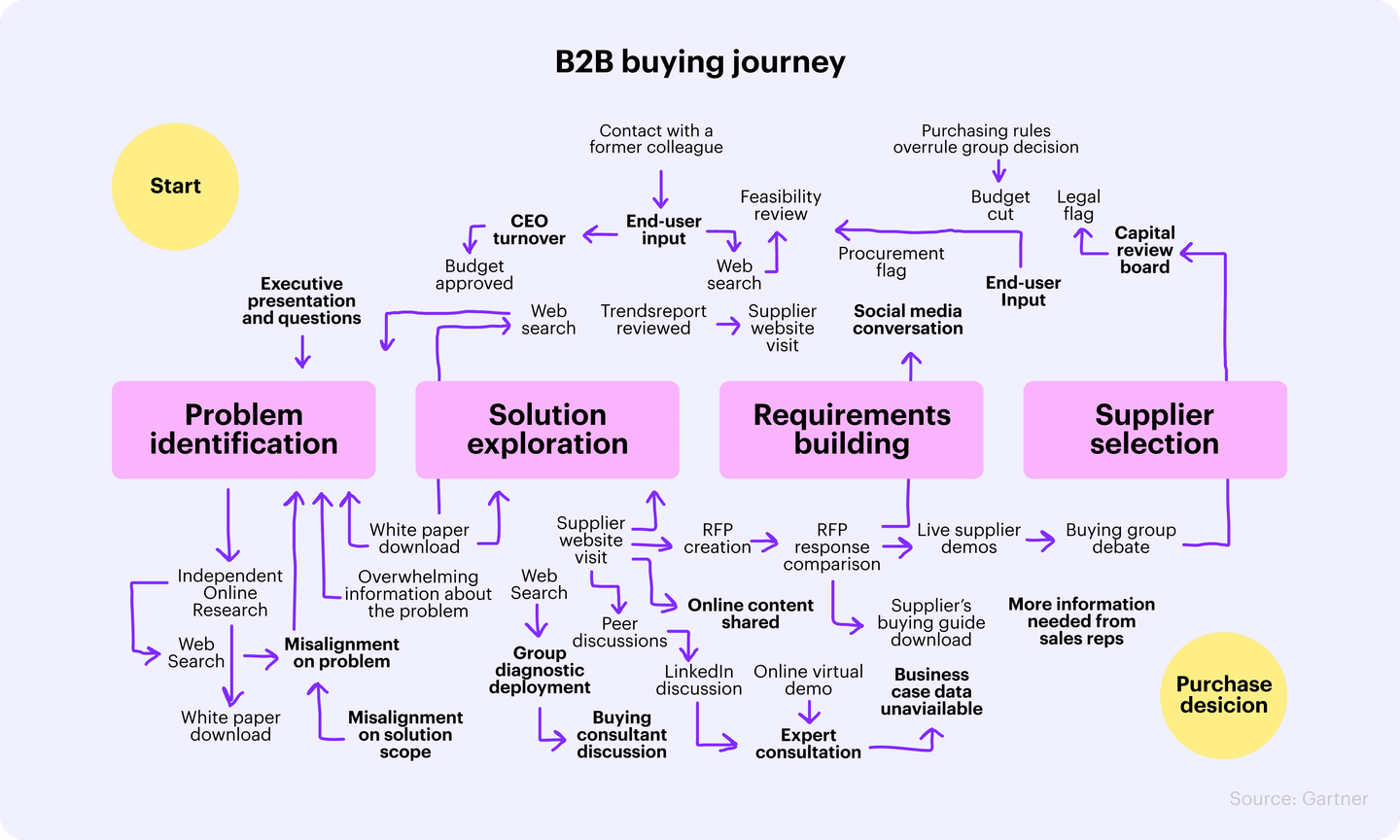
Influ2's B2B Enterprise Buying Journey Survey reinforces this.
When we asked enterprise software buyers what most often slows down a purchase decision, the top two answers were budget approval and getting internal alignment.
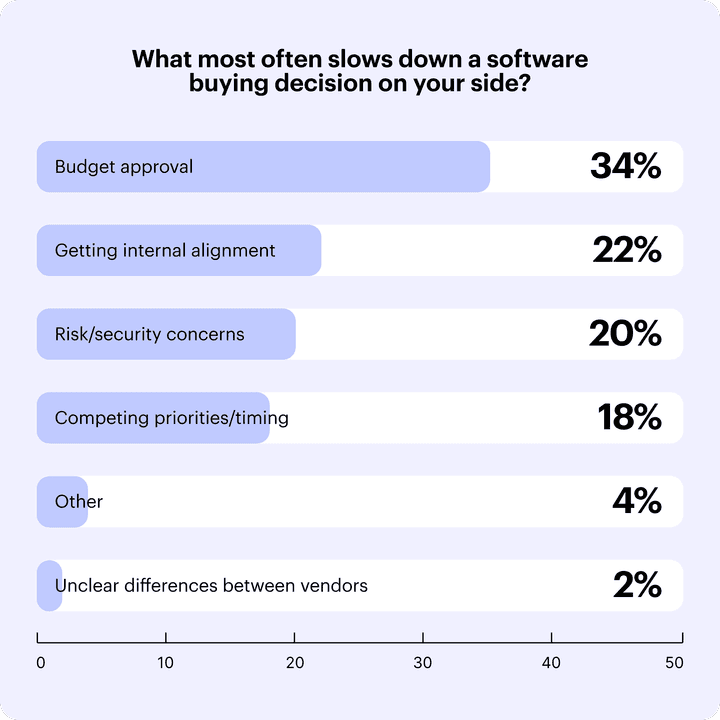
None of those are problems a linear funnel model solves for. They're problems of timing, consensus, and organizational dynamics.
Research also shows that 81% of B2B buyers already have a preferred vendor by the time they first make contact with sales, per Forrester’s State of B2B Buying report.
And our own data found that 74% of enterprise software buyers are evaluating 3-5 vendors at the same time.
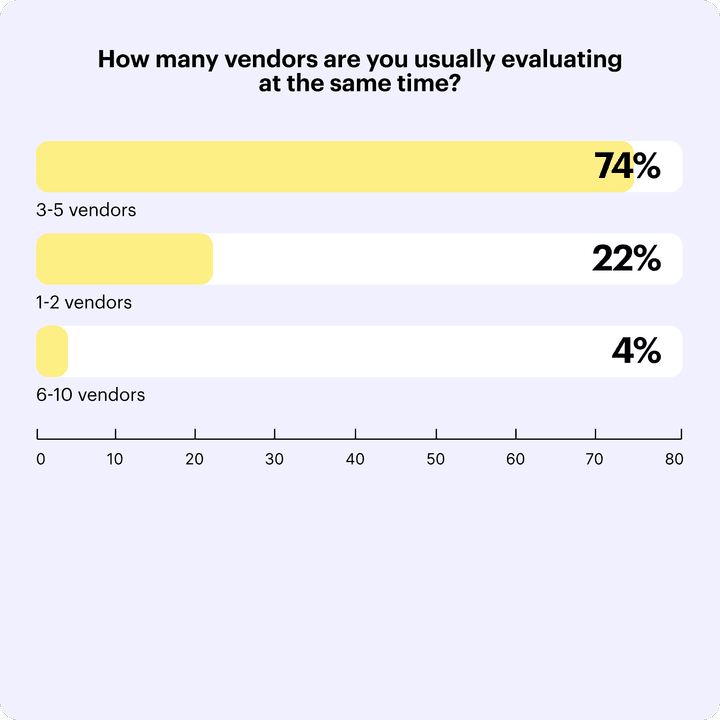
That means the buying decision is being shaped long before a demo gets booked.
If your GTM strategy isn't built for this non-linear journey, you can't influence your buyers in meaningful ways.
So, how do you adapt sales and marketing processes, tools, and strategies to reflect real life rather than a fairy tale?
Support self-serve buyer research, even in ‘dark’ spaces
B2B buyers spend the majority of their journey self-educating long before they reach out to a salesperson.
Gartner found that when B2B buyers are considering a purchase, they spend only 17% of that time meeting with potential suppliers, and even less (5-6%) when comparing multiple suppliers. And 75% prefer rep-free experiences altogether.
On top of this, more of the buying journey now happens in the Dark Funnel. The places you can't easily track, like
- Slack groups
- Internal meetings
- LinkedIn messages
- Private communities
- AI assistant conversations
- Cookie-less browning sessions
Research suggests roughly 70% of the B2B buying journey happens in these invisible channels before any vendor contact form is filled.
Katya Tarapovskaia, co-founder and Head of AI & Marketing Solutions at YouStellar, has adapted her content strategy around this reality.
She over-indexes on what she calls "steal-able" content: opinionated, practitioner-specific thought leadership that survives being ripped out of context and dropped into a DM. "If a piece needs the surrounding article to make sense," she says, "it dies in the dark funnel."
The dark funnel taught me that influence and trackability are two different things, and most of us were optimising for the wrong one.
Ultimately, sales reps have smaller windows to impact buying decisions. By the time a meeting's set, the buyer's mind is close to made up through self-serve research and internal conversations.
Here’s how to support self-serve research:
1. Create resources and buyer enablement content for a variety of buyer personas, pain points, and stages
Your content should help different job roles answer questions, compare solutions, understand features, address implementation concerns, and visualize the valuable outcomes they’ll achieve.
For example, Chief Marketing Officer Sam wants to understand:
- How are other CMO’s dealing with this issue? A webinar or panel interview lets Sam hear from peers how common this challenge is, and how other CMOs solve it.
- Will implementing a solution totally disrupt our team? An Implementation Guide or one-sheeter answers common questions, explains implementation milestones, and offers a sample roadmap.
But, Sam’s Senior Marketing Manager Beth? She’s wondering:
- Which solution makes it easier to run more advanced campaigns? A Product Comparison webpage helps Beth evaluate popular products’ features, use cases, and customer ratings against one another.
- How big is the learning curve? A Virtual demo helps Beth check out the UI and visualize how her team will use the solution.
Blog posts, case studies, videos, interviews, ROI calculators, trend reports, and more help Sam and his team find information that matters most to their roles and buying considerations.
It seems like a lot, but speed up content creation by repurposing a larger initiative – like a report, interview, or webinar – into smaller pieces (like a blog post or social carousel).
Then, further tailor content pieces to each persona to deliver helpful resources across the buying committee.
2. Launch engagement-based ad journeys
Engagement-based ad journeys serve highly personalized content to a targeted contact, and then shift future messaging based on how that person interacts.
Here’s what an engagement-based ad journey might look like for Sam:
- Initially, Sam sees ads with pain point-specific messaging, like how simplifying your tech stack improves reporting.
- Since Sam clicks the ad, he’ll next see more advanced content, like a case study: Fortune 500 CMO Cuts Reporting Time by 73%.
- Soon, Sam signs up for the free trial and starts seeing ads featuring the sales rep assigned to his account. At Influ2, we call these “high-impact ads that make a direct connection between Sam and the SDR.
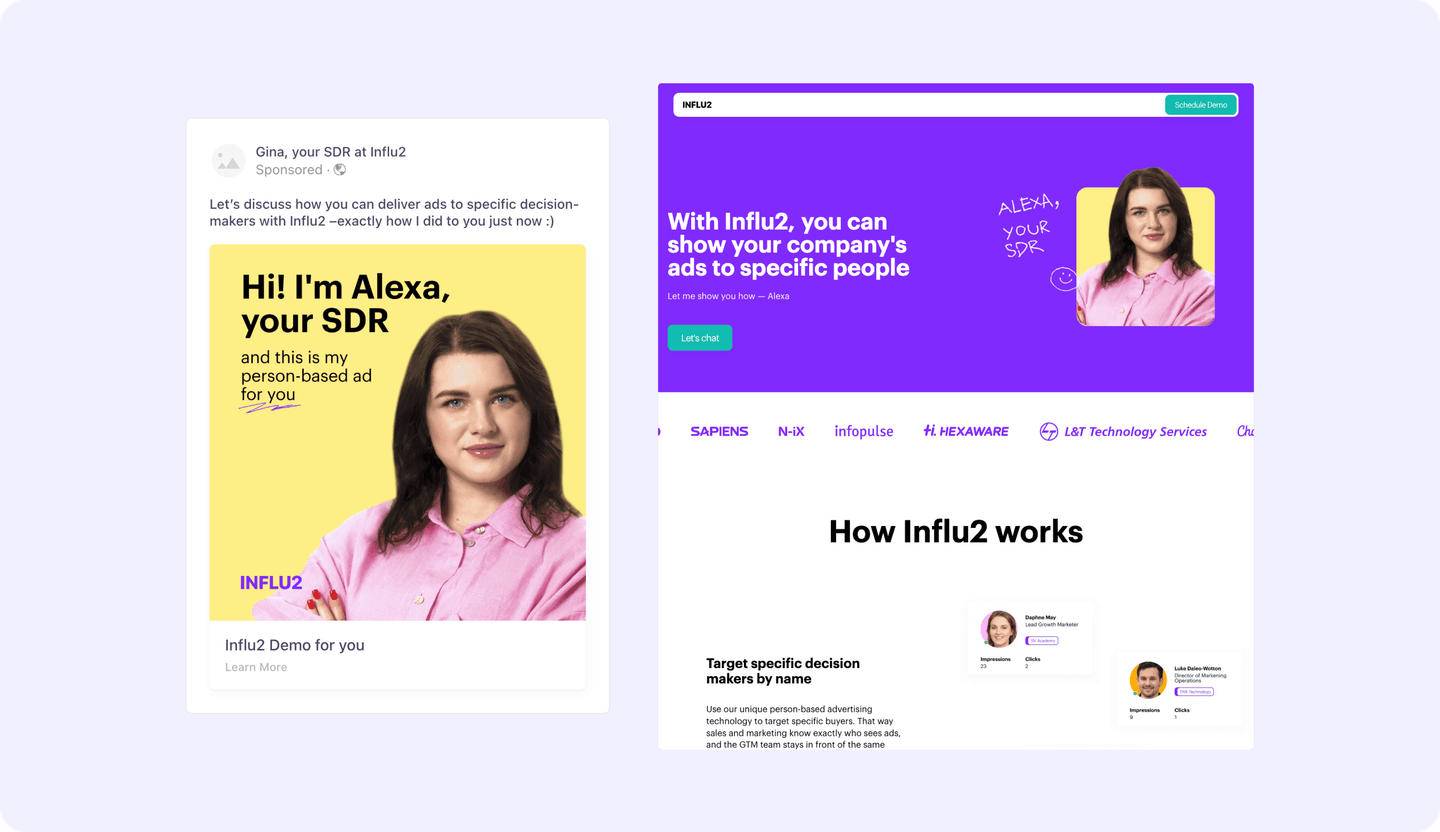
Engagement-based ad sequences help you capitalize on moments of heightened activity by serving advanced content or, change messaging when activity ebbs – reflecting a realistic buyer journey, with all its ups and downs.
If you want to learn more about how our team uses engagement signals across multi-month buyer journeys, check out our ABM Framework.
3. Sales needs to recognize re-engagement patterns (not just look at last touchpoints)
Like a breadcrumb trail, review combinations of data points to figure out buyers’ challenges, interests, and urgency.
Focus on who’s engaging, what they’re engaging with, and when that engagement is happening to effectively time outreach and personalize conversations.
Examples of high-intent re-engagement signals to watch for:
- Previously inactive lead now binge-reads multiple content pages.
- Key stakeholders or multiple individuals from the same company visit BOFU webpages within a close timeframe (e.g., the CFO and two marketing managers read your pricing page in the same week).
- Buyer signs up for a live demo, watches a video, or views an interactive demo.
- Inactive lead reads older marketing emails or replies to an old email thread, after a sales conversation went cold.
- Past prospect lost due to budget constraints now clicks your re-engagement ad.
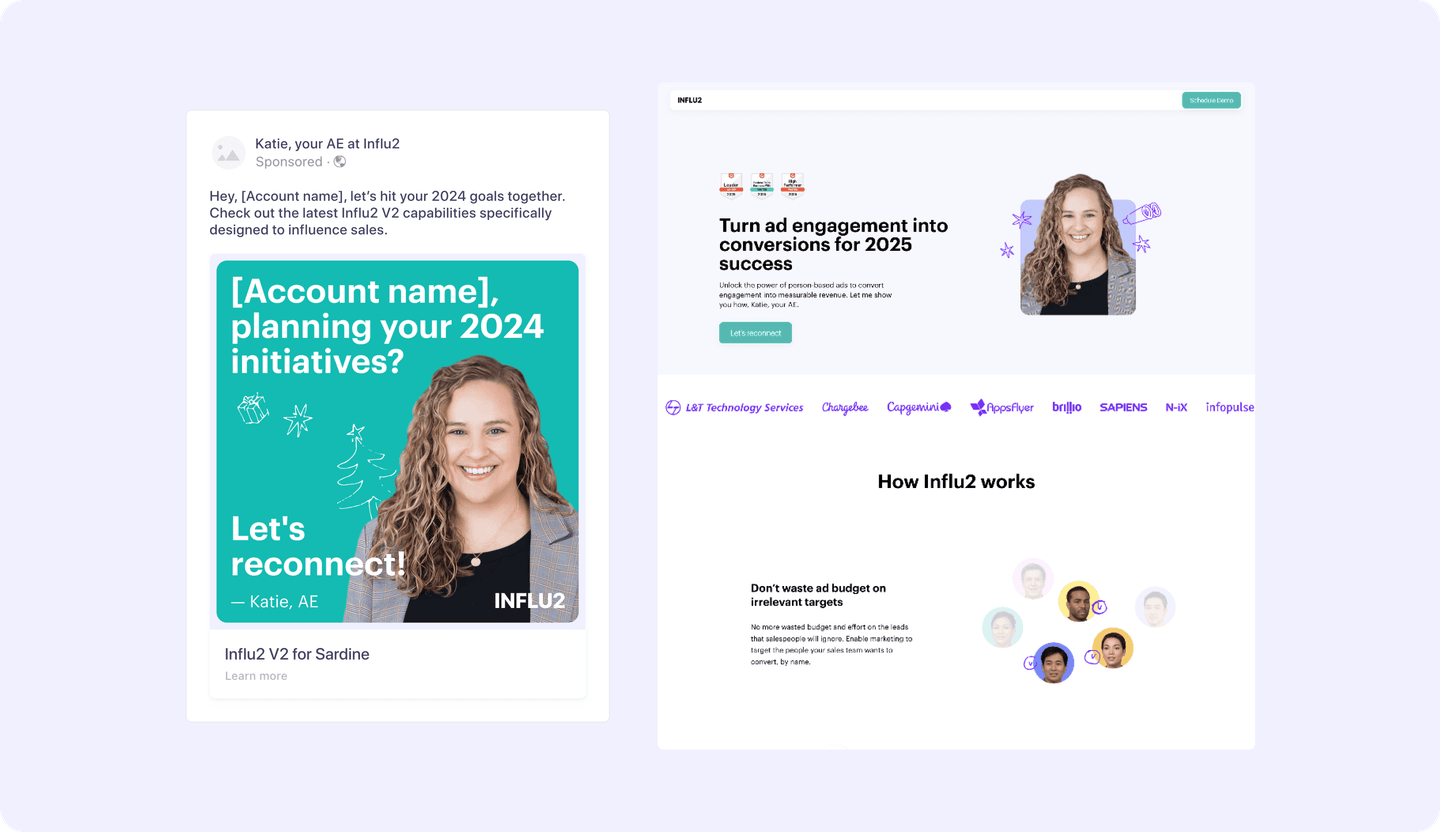
Katya Tarapovskaia describes the cluster signal her team trusts most:
A single contact re-reading a blog is curiosity. Three people from the same company, including someone who's never touched us before, hitting bottom-of-funnel pages in the same week? That's a buying committee reconvening and building a broader business case.
The pattern she watches for is recency, concentration, and a new face in the cluster. An isolated signal can be noise, but a cluster from the same account means the internal clock just started ticking again.
These re-engagement signals suggest your buyer is busy doing self-serve research and that internal conversations are happening at the company.
Here’s Tarapovskaia's approach to accounts that go quiet. Her team doesn't pause the program but shifts from what she calls "activation mode" to "ambient visibility," widening outreach to secondary personas (IT, finance, ops) to find where the deal has actually stalled.
We also love this advice from Amanda Hunter, Marketing & ABM Strategist at Amanda In Motion, on prioritizing engagement signals.
Sell across the account buying committee, while personalizing the experience
In enterprise B2B sales, you’re never selling to just one person. You need to win over the entire buying committee (e.g., the boss, end-users, IT, and finance).
Buying committees are only getting larger, at a time when everyone is scrutinizing budgets. The result is longer sales cycles, rife with indecision. Gaining consensus is the most challenging stage.
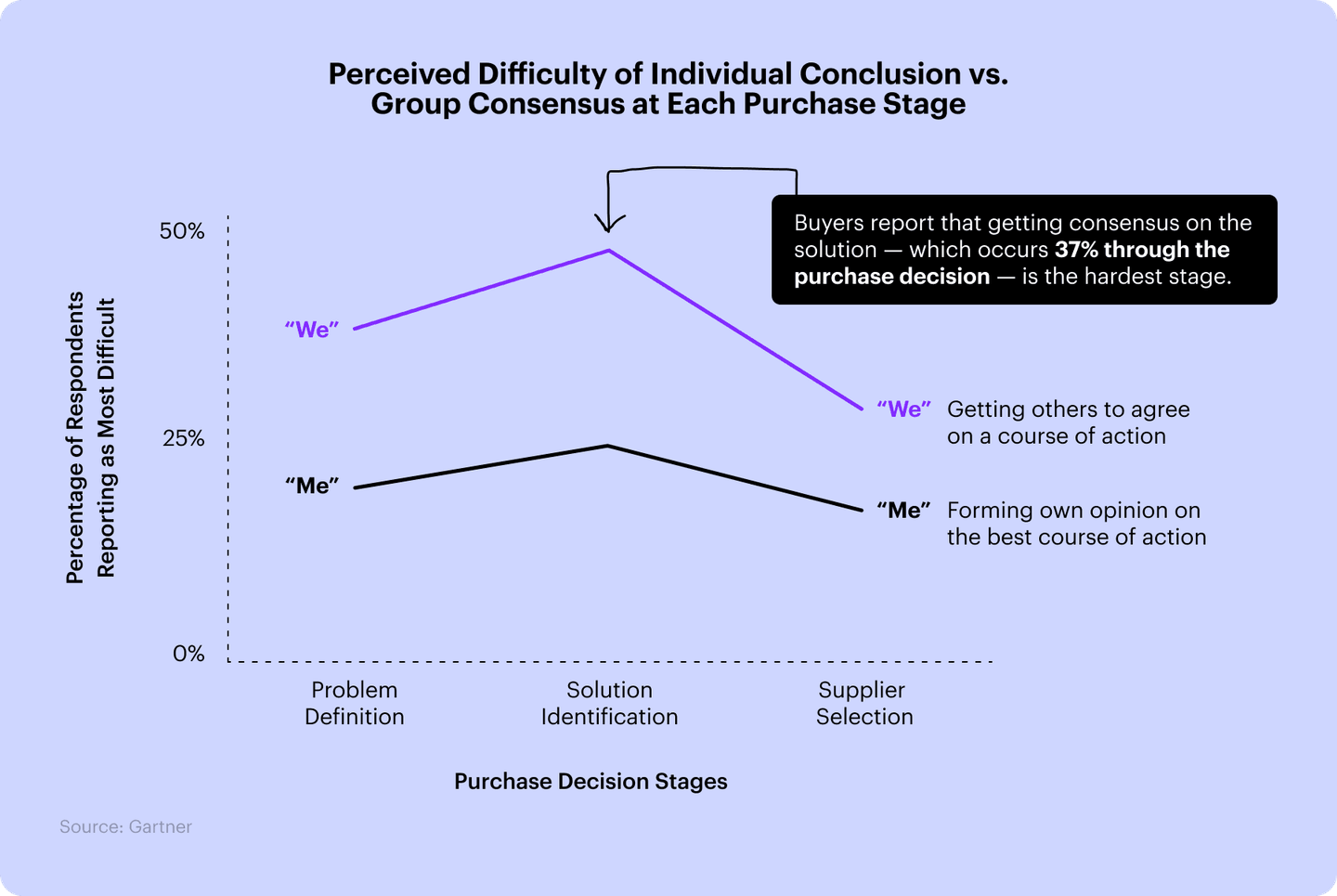
Influ2's B2B Enterprise Buying Journey Survey found that enterprise buyers consistently flag internal alignment, not just budget, as their biggest obstacle. One senior learning and development leader at a large enterprise put it directly: "In large companies it's about matching the values and procedures of that company and influencing broadly. Literally one person can sink a ship."
Emily Yorke-Goldney, Director of Global ABM at Clarify, pointed out the core failure point in how most organizations handle this:
We've become very good at identifying intent and very poor at operationalizing it. Most organizations can tell you which individual engaged with content, but far fewer can tell you whether a buying group is forming.
Her framing for the fix is to shift from lead scoring to buying group activation, asking not just who engaged but whether multiple stakeholders are moving together, and what that signals about where the deal actually stands.
You're going to need to understand the makeup of the buying committee and each role's biggest challenges, turn-offs, and goals. Arm yourself with success stories, proof points, rebuttals, and examples to answer each person's questions and personalize your pitch.
Tarapovskaia frames her own typical enterprise committee as a three-way triangle. The CMO or VP who owns the vision, the Head of Demand Gen or ABM Manager who will own implementation, and the RevOps or IT stakeholder who controls the stack. Each is afraid of something different: the CMO wants outcome and peer proof, the implementation lead wants product depth and practicality, and IT wants integration answers and security assurance.
The mistake that loses deals is sending the CMO's strategic narrative to the IT evaluator, which reads as fluff, and you lose the veto-holder before the deal ever surfaces.
Here’s how to sell across buying committees:
1. Embrace multi-threaded outreach by serving content to multiple stakeholders (across teams) within an account
Deals are 37% more likely to close when more than one contact is engaged, and cross-department threading has the potential to increase win rates by 56%.
Makes sense, right: if sales, marketing, and IT are all making the case for a new solution, it’s going to be an easier sell to leadership.
Use these tactics to take a multi-threaded outreach approach:
- Don’t put all your eggs in one basket – nurture relationships and find Champions at different seniority levels and departments.
- Send targeted emails with content specific to role and level, to start creating brand awareness, generating excitement, and resolving unanswered questions.
- Deploy contact-level advertising across the buying committee, advancing content strategy based on engagement (e.g., engagement-ad sequences).
- Ask your internal Champions for introductions, or ask “who else should join the conversation” early on to start opening doors across departments.
- Look to your network and team members to see who has connections (particularly to leadership) within the account to make introductions.
A huge benefit to multi-threading is your deal doesn’t die if your Champion leaves or gets busy. You have multiple relationships to lean on, build internal buy-in, and continue to advance momentum across the account.
2. Equip champions with internal selling materials to help them persuade their team
Sales decisions happen when you're not in the room.
If your Champion isn’t armed with the right information, they may struggle to advocate for your solution.
First, map out the buying committee – who makes the decisions, what roadblocks they face, and what they care about most.
Keep in mind that people who object and slow down the journey aren’t always the ones who make the final decision. You need to address both.
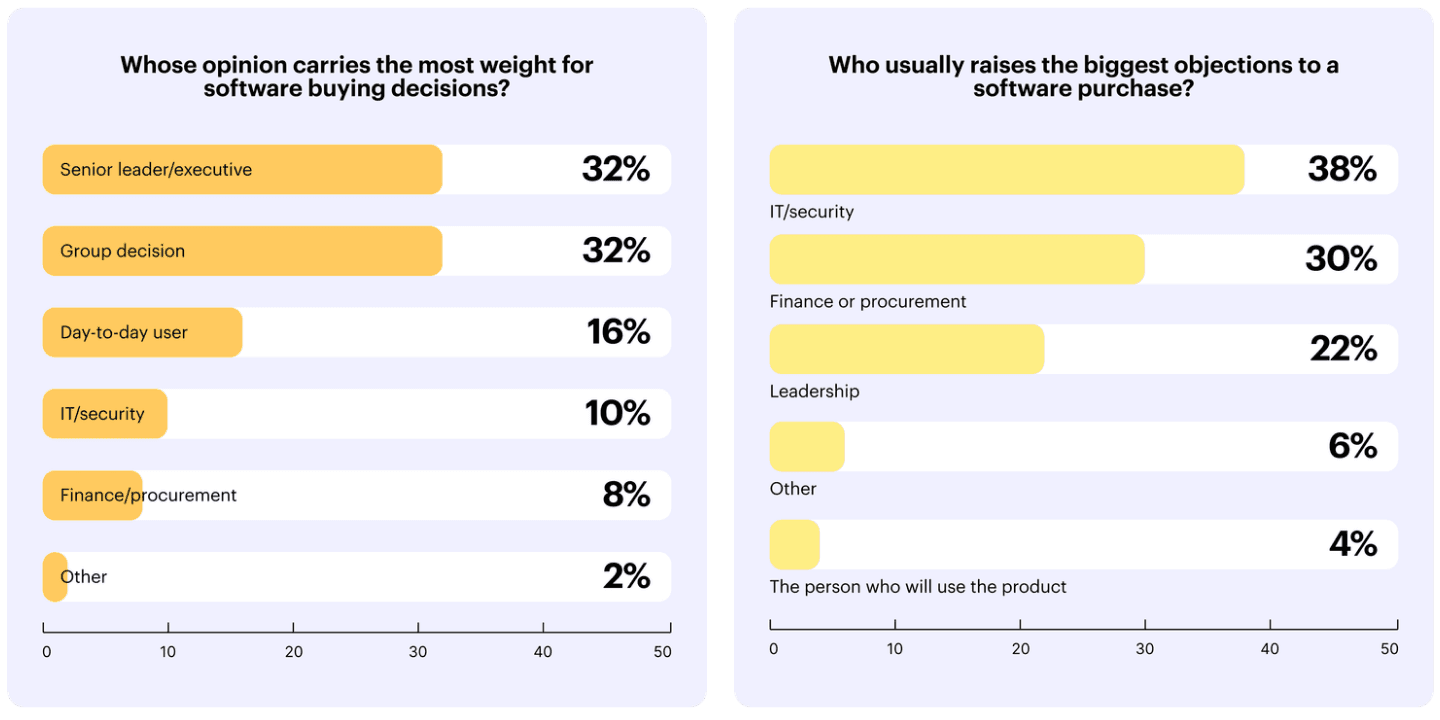
Then, equip your Champion with resources to answer questions and address hesitations:
- Pre-recorded demos, so they don’t have to explain everything themselves.
- Competitor comparison sheets to proactively address internal objections.
- Customized presentation decks to take into internal meetings.
- Testimonials and case studies to demonstrate proof points and real user experiences.
- Business impact content to answer executive-level questions around costs, ROI, competitive advantage, and industry benchmarks.
- Your subject matter experts (SME) to support internal conversations, answer questions, and ease concerns.
Think about the materials you lean on most throughout a sales journey and package them up for your Champion, so they don’t need to work harder to guide the sales conversation.
Don't just throw a bunch of materials over the fence. Make sure your champion knows how to use each piece and when, encouraging them to pull you into any conversations to offer support.
Tarapovskaia suggests treating the buying committee like a micro-ABM program within the account. Each persona gets their own content track, journey, and angle, so no one is a stranger when the vote happens.
Adapt tools and processes to gain a clear picture across the entire account
Most tools still reflect the linear buying journey and work at the account level, which means you're not getting reliable data to truly understand each buyer as they crisscross through the decision-making process.
As a result, you end up triggering content and campaigns based on unreliable data, making it nearly impossible to target opportune moments in the buyers’ journey.
Thankfully, MarTech has come a long way. To get better insights into where buyers are in the journey and orchestrate your GTM program around individual behavior, look for tools that:
1. Track the entire buying committee, not just one person
One of the biggest mistakes you can make is treating an entire account as if it were one person. Buying decisions are made by a group of people, so you need a holistic view of what each person is doing and how your program influences them.
This holistic view helps:
- Revenue teams tailor GTM motions for incremental improvement, better allocate budget, and accurately attribute marketing and sales influence
- Marketing warm up contacts with hyper-relevant content and improve campaign performance
- Sales prioritize lead follow-up and guide more meaningful conversations
Influ2 is a contact-level ABM platform that gives this holistic view across the buying committee. For example, you can see:
- The different contacts you're targeting in the buying committee
- The ads they see (now and historically)
- The actions they take with each ad
- Signals for the entire buying committee plus a summary of what they care about most
- KPIs like reach, influence, impressions, clicks, and CTR at both the cohort and individual contact level
This replaces the idea of buying committees as faceless lists of roles and pain points, and shows how your program influences the buying journeys.
2. Use contact-level intent to determine the next best action
Knowing where a buyer is in their journey is one thing. Taking the right action based on that information is what actually makes it valuable. Like Tarapovskaia told us, "A signal sitting in a dashboard is a signal that doesn't exist."
Influ2 makes it easier to act on your signals by orchestrating at the contact level.
- Add the people in the buying committee to Influ2 (can be synced directly from your CRM)
- Track relevant contact-level signals from each person (what they search, read, click, download, and attend)
- Map each buyer’s signals across channels to the topics they care about
- Trigger relevant ads, sales follow-up from Salesloft or Outreach, and emails from Salesforce or HubSpot that automatically adjust based on buyer behavior
B2B journeys, like people, are unpredictable
B2B buyers are people. And people move at their own pace, get influenced by shifting priorities, have internal debates, and go through countless digital touchpoints. They’re busy, conflicted, and risk-averse.
The B2B buyer's journey isn't simple and tidy, and the linear model is little more than useful fiction.
By adapting your GTM strategy, you can meet buyers exactly where they are and guide decisions.
With Influ2, you can do this for every contact or zoom out to see the big picture of the entire buying committee. That's what a GTM strategy built for the real B2B buyer journey looks like.
FAQ: B2B Buyer's Journey
What are the stages of the B2B buyer's journey?
The traditional B2B buyer's journey has three stages: awareness (the buyer recognizes a problem), consideration (the buyer evaluates solutions), and decision (the buyer selects a vendor). In practice, enterprise buyers loop through these stages multiple times over months, with different stakeholders entering and exiting at different points. The journey rarely ends at purchase either; post-sale expansion and renewal are increasingly treated as their own buying cycles.
How long does the average B2B buyer's journey take?
Dreamdata's 2025 benchmarks put the average B2B customer journey at 211 days and 76 touchpoints. Enterprise deals run significantly longer, particularly when security reviews, legal, procurement, and executive sign-off are all required. The key implication for marketing: consistent presence throughout the journey matters more than heavy investment at any single stage.
What is the dark funnel in B2B buying?
The dark funnel refers to the portion of the B2B buying journey that happens in places you can't track: private Slack groups, internal meetings, peer conversations on LinkedIn, AI assistant queries, community forums, and industry podcasts. Research suggests roughly 70% of the buying journey happens in these channels before a buyer ever fills out a form. Strategies that only account for trackable intent signals are missing most of the actual decision-making process.
How do you influence buyers earlier in the B2B buying journey?
Start with content that addresses the buyer's problem before they're ready to talk to sales: educational blog posts, peer interviews, ROI calculators, and comparison resources. Run consistent contact-level advertising to stay visible to specific decision-makers at your target accounts, even during quiet periods. And monitor re-engagement signals (ad clicks, content binge-reading, return website visits) to identify when a buyer's urgency is picking back up, so sales can time outreach to match the buyer's actual readiness rather than an arbitrary pipeline stage.

Dominique Jackson is a Content Marketer Manager at Influ2. Over the past 10 years, he has worked with startups and enterprise B2B SaaS companies to boost pipeline and revenue through strategic content initiatives.

