6 Best ABM Tools for Advertising


Advertising is a staple channel for account-based marketing programs.
The problem is, most ad campaigns are ineffective at reaching actual decision-makers.
In a study we commissioned with Forrester, ABM practitioners told us that the biggest factors holding back program effectiveness were:
- Identifying the right buyers
- Engaging with those buyers at the right time
- Personalizing ABM programs at scale
It's not an alignment or skill problem. It's a toolset problem.
Marketers are bottlenecked by ABM advertising tools that don’t let them get past the account level.
This guide explains why being able to target at the contact level is critical for B2B teams and explores the pros and cons of six advertising tools found in most ABM tech stacks.
Why contact-level advertising is a necessity for modern ABM teams
It's the “account” in account-based marketing that’s holding most ABM advertising tools back.
Don’t get me wrong.
Selecting ideal accounts to go after and then pursuing them with targeted outreach and ad programs is the right move for B2B (especially when selling into enterprise).
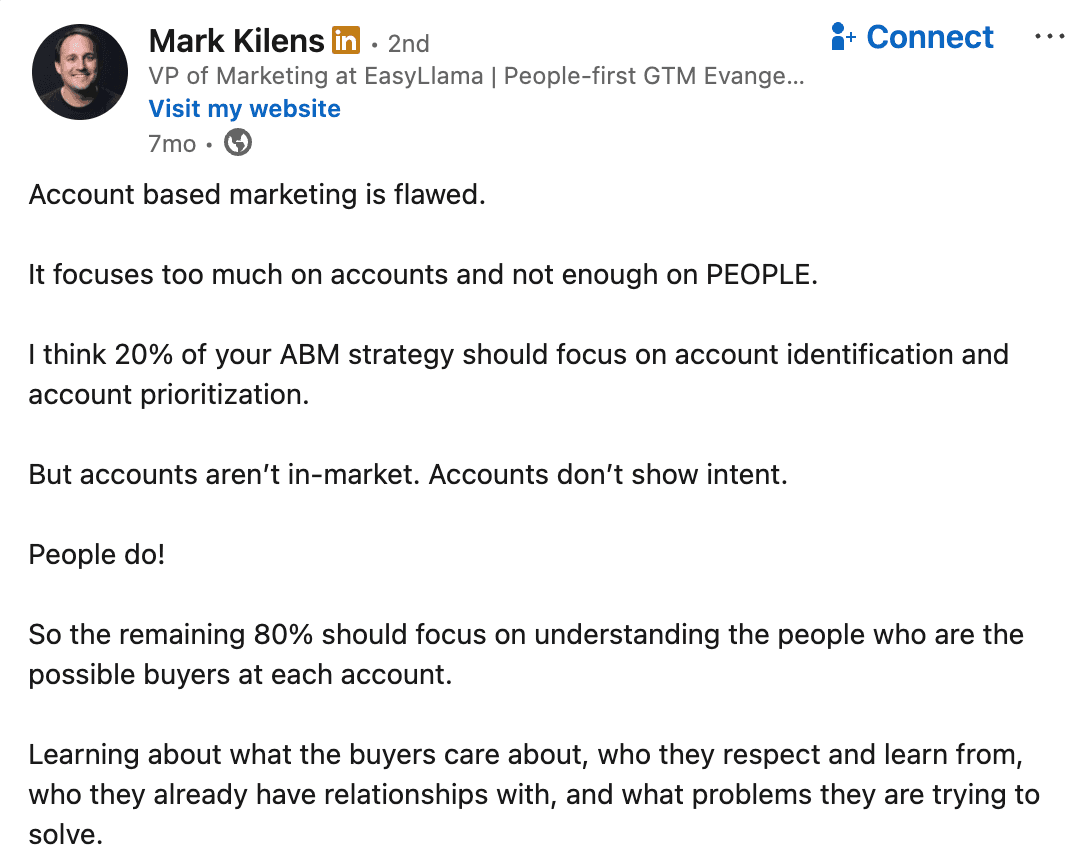
The problem is that the majority of ABM advertising tools only let you run ads at the account level. But it's not accounts that make buying decisions; it's people within them.
That’s not super helpful when you’re targeting a company like Apple. Even if you decide to target only sales and support, you’re still talking about 11,000+ people.
Mark Kilens of EasyLlama sums it up pretty well:
To reach the people with the power to make a purchase decision—those 13 or so that make up the typical enterprise buying group—marketers need contact-level advertising tools.
- Contact-level advertising tools allow you to specify the exact prospects you want to reach, and show them ads tailored to their role, intent, or stage in their buyer journey.
- Account-level advertising tools force you to run ads across the entire account (or a department within it), creating a ton of wasted spend on people you don’t want to reach.
It's not just your ad program that needs to be contact-level, though. You also need access to contact-level intent data and buying signals, so marketers can tailor more relevant ad journeys and reps can tackle real stakeholder objections head-on.
These constraints are pushing ABM teams to look beyond account-level advertising and assess which tools can actually support precision, relevance, and commercial accountability. With that context in mind, here’s how six common ABM advertising tools stack up in practice.
1. Influ2
Influ2 is the only ABM tool that lets you show ads directly to named contacts, track when and how they engage, and tie it back to revenue and pipeline.
Running an ABM program means you’re working with a small number of high-value accounts over long buying cycles, where multiple stakeholders with different priorities are involved.
Account and role-based targeting alone aren’t going to cut it.
You need to reach real decision-makers, with ads that are relevant to their intent, engagement, and stage in the buyer journey.
Only contact-level advertising can give you that.
We built Influ2 to help ABM teams:
- Target only specified contacts you choose, not anonymous audiences or inferred roles
- Launch contact-level ads across multiple channels (LinkedIn, Meta, Google, Bing, and more) from a single interface, without fragmenting execution or reporting
- Orchestrate custom buyer journeys that deliver different messages based on each contact’s sales stage, deal status, demonstrated intent, and ad engagement
- Coordinate Marketing and Sales by alerting reps when named contacts engage with your ads, including full context on what they viewed or clicked
- Generate contact-level intent through ads, not just capture it, by testing messaging directly in front of selected decision-makers and seeing what resonates before outreach
- Measure and prove marketing influence on pipeline and revenue at the contact level, without relying on web form fills, cookies, or IP targeting
Influ2 is a good fit for your ABM team if:
- You need ads that reliably reach specific decision-makers, not broad account or role-based audiences
- You’re advertising to multiple stakeholders with different priorities, and need ads tailored to roles and buying stages rather than a single account-level message
- You want to see which individual stakeholders are engaging with your ads, when they engage, and what messaging resonates
- Your advertising budget is focused on a small set of high-value accounts, where wasted impressions matter and precision matters more than scale
- You need to measure the impact of advertising on pipeline and revenue by tying ad engagement back to named contacts and deals, not just impressions and clicks
2. 6sense
6sense is an ABM platform with a focus on predictive analytics, telling revenue teams which accounts to target based on intent signals, engagement data, and estimated buyer journey stage.
Its advertising offering is built around a demand-side platform (DSP) that allows ABM teams to run ads across display, social, paid search, and Connected TV (CTV).
6sense doesn’t have the contact-level targeting abilities of Influ2. Instead, the Audience Builder tool lets marketers use firmographic, technographic, and behavioral filters to set up dynamic audience segments.
Key features:
- Pre-built campaign templates: 6sense offers out-of-the-box playbooks for use cases like engaging accounts with open opportunities or re-engaging dormant audiences.
- Dynamic audience segmentation: Ad audiences built using 6sense’s Audience Builder automatically refresh as new accounts meet segment criteria.
- Integration with sales priorities: ABM teams can set up predictive scoring criteria so that when accounts reach a certain threshold, they are automatically moved into ad campaigns alongside sales outreach programs.
Trade-offs:
- Advertising capabilities are limited to the account-level, meaning teams can’t specify exact contacts they want to target
- The DSP isn’t super B2B-focused, so ad spend isn’t as optimized as it could be
- 6sense’s primary strength is in intent data and predictive analytics, not advertising execution
See what users are saying about 6sense on G2.
3. Demandbase
Demandbase is a legacy ABM platform with its own B2B DSP, which allows ABM teams to run ads across social, display, native, video, and CTV.
Advertising is integrated into Demandbase’s broader offering, which includes intent data, account scoring, and sales orchestration, meaning teams can coordinate efforts across multiple channels rather than operating in siloes.
However, Demandbase only provides targeting at the account level, not at the individual contact or person level. Where Influ2 allows ABM teams to target specified contacts with relevant ad programs, Demandbase restricts marketers to broader persona-driven approaches.
Key features:
- Account intelligence: Teams can build ad segments based on Demandbase’s account intelligence, which includes buying group, intent, behavioral, and CRM signals
- Buyers’ journeys: Marketers can design ad programs that automatically align every creative to the accounts’ stage, without manual adjustments.
- AdsIQ: Automated ad bidding technology automatically balances bids, frequency, and spend based on account size and intent signals to optimize spend.
Trade-offs:
- You can’t target at the contact level, only to accounts
- Ad reporting can tell you which account engaged, but not the specific decision-maker inside that account
- Being a complex legacy platform, rather than an advertising-first ABM tool, setup and implementation can be long-winded and costly
See what users are saying about Demandbase on G2.
4. AdRoll ABM (formerly RollWorks)
AdRoll ABM is pretty aptly named: it's the ABM version of AdRoll, the more B2C-focused digital advertising platform.
Previously named RollWorks, AdRoll ABM provides straightforward account-level advertising across common channels—display, CTV, native, video, and social.
Think of it as a lite version of other ABM tools on the list. It has clean reporting and some predictive capabilities (though not as advanced or customizable as 6sense), and a fast, easy account-level ad campaign builder (but it doesn’t offer contact-level targeting or engagement data like Influ2).
Key features:
- Native DSP: ABM teams can manage ad spend and optimize channel mix across display, video, and social media (LinkedIn and Facebook).
- Website visitor retargeting: AdRoll ABM can identify anonymous website visitors (company domains) and add them to retargeting campaigns.
- AI bid optimisation (BidIQ): The platform automatically adjusts bids and spend based on what’s working.
Trade-offs:
- AdRoll ABM targets accounts, not people
- You can’t see who (by name) saw or clicked on your ads
- Dashboards and campaign metrics are more basic than tools with deep analytical engines
See what users are saying about AdRoll ABM on G2.
5. Terminus/Demandscience
Terminus was an account-level advertising and orchestration tool. In 2024, it was acquired by and merged into DemandScience, creating a broader B2B demand generation and ABM offering.
Account-centric display and retargeting ad campaigns are still core offerings, making DemandScience well-suited to teams that need large-scale reach.
What DemandScience misses, and where it falls short for most teams running ABM motions, is the ability to build contact-level ad campaigns, which Influ2 provides. It also places less of an emphasis on revenue intelligence and deep ABM orchestration, so it's less powerful in that respect compared to the likes of 6sense or Demandbase.
Key features:
- B2B ads: DemandScience’s ad offering is built around programmatic account-level display, though they also offer social, video, and audio advertising.
- Retargeting: The platform uses IP-based matching to identify and retarget accounts that have visited your website.
- DemandScience Media Placement & Management: For teams that prefer a hands-off approach, DemandScience can take care of buying, pacing, and frequency management.
Trade-offs:
- Account-level targeting means teams can’t reach buyers at the contact-level or see who within an account saw or clicked an ad
- High-level reporting with limited ability to measure impact on revenue
- No proprietary DSP, meaning campaign activation relies on partner DSPs and networks
See what users are saying about DemandScience on G2.
6. ZoomInfo Marketing
ZoomInfo Marketing’s advertising is built primarily around its partnership with The Trade Desk, allowing it to offer its own native DSP.
You can build highly specific audiences based on firmographic and contact data, and use ZoomInfo’s intent signals as an input for segmentation and targeting.
Compared to Influ2, ZoomInfo offers less-specific targeting—you can’t specify prospects to show ads to, or see who viewed or clicked your ads.
Key features:
- Intent-based ad targeting: You can shape advertising audiences using intent signals (which companies are actively researching topics related to your product)
- Advanced segmentation: Marketers can segment audiences using more than 300 company attributes, such as industry, tech stack, behavior, and intent
- Cross-channel advertising: Teams can build ad programs that run across display, social, and CTV
Trade-offs:
- Most of ZoomInfo’s ad offering happens through partners, rather than proprietary networks or DSPs
- No contact-level ad targeting or engagement reporting
- Reporting overall is focused on higher-level KPIs (impressions, clicks by segment) rather than detailed buyer-level attribution
See what users are saying about ZoomInfo Marketing on G2.
ABM tools for advertising comparison table
| Platform | Core strength | Advertising capabilities | Targeting level | Intent data | Reporting and measurement |
| Influ2 | True contact-level ABM advertising | Cross-channel contact-level ads across LinkedIn, Facebook, Instagram, Google, Bing, and more | Contact level | Contact-level intent generated and observed across ads, search, social, and third-party content | Direct pipeline and revenue impact tied to named contacts |
| 6sense | Predictive account prioritization | Built-in DSP for display, social, search, and CTV advertising | Account level | Third-party intent from Bombora, G2, and publisher networks | Customizable reporting focused on account engagement and pipeline influence |
| Demandbase | Broad enterprise ABM and ad orchestration | Native DSP across display, social, video, and CTV | Account level | Bombora plus proprietary intent network | Account-level engagement analytics tied to pipeline |
| AdRoll ABM/RollWorks | Advertising-led ABM activation | Native DSP for display, video, and social with AI bid optimization | Account level | Bombora, optional G2, plus search behavior signals | Basic campaign and engagement reporting |
| Demandscience/Terminus | Scaled B2B account-level ad reach | Programmatic account-level display, plus social, video, and audio | Account level | Aggregated behavioral and content consumption signals | High-level reach and engagement metrics |
| ZoomInfo Marketing | Data-driven audience activation | Advertising via partners, including The Trade Desk, across display, social, and CTV | Account level | Bombora intent plus firmographic and behavioral signals | Activity and reach-focused reporting, limited revenue attribution |

Dominique Jackson is a Content Marketer Manager at Influ2. Over the past 10 years, he has worked with startups and enterprise B2B SaaS companies to boost pipeline and revenue through strategic content initiatives.

