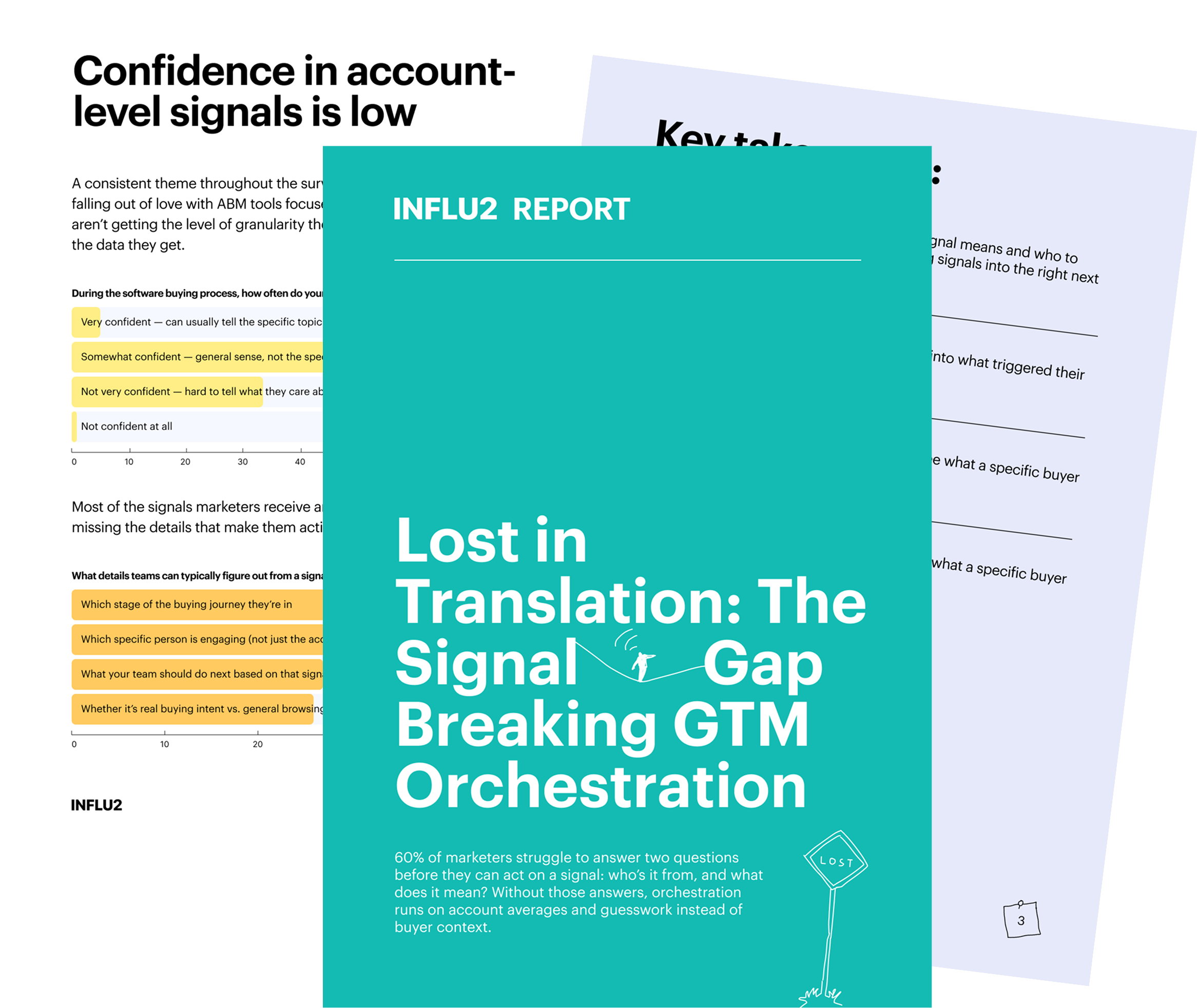
Influ2 Report
Lost in Translation: The Signal Gap Breaking GTM Orchestration
60% of marketers struggle to answer two questions before they can act on a signal: who’s it from, and what does it mean? Without those answers, orchestration runs on account averages and guesswork instead of buyer context.

We surveyed 101 senior-level marketers and interviewed experts from leading B2B brands to understand what’s stopping teams from turning signals into well-orchestrated action.
This report shares insights into how marketing teams use signals today, where the bottlenecks are, and what better context would change about how they orchestrate.
Download the full report to learn:
- Why having more signals doesn’t produce a clear picture of an individual buyer
- Why the "high-intent" labels most ABM tools surface leave marketers with more questions than answers
- What teams say they'd do differently with contact-level signals
Including insights from

Gal Fontyn

SVP Marketing at WalkMe

Jerry Henry
Sr. Marketing Manager, Field and Partners at Remarcable

Anda Stafa
Digital Marketing Manager at Archipelago

Emily Yorke-Goldney
Global ABM Director at Clarify
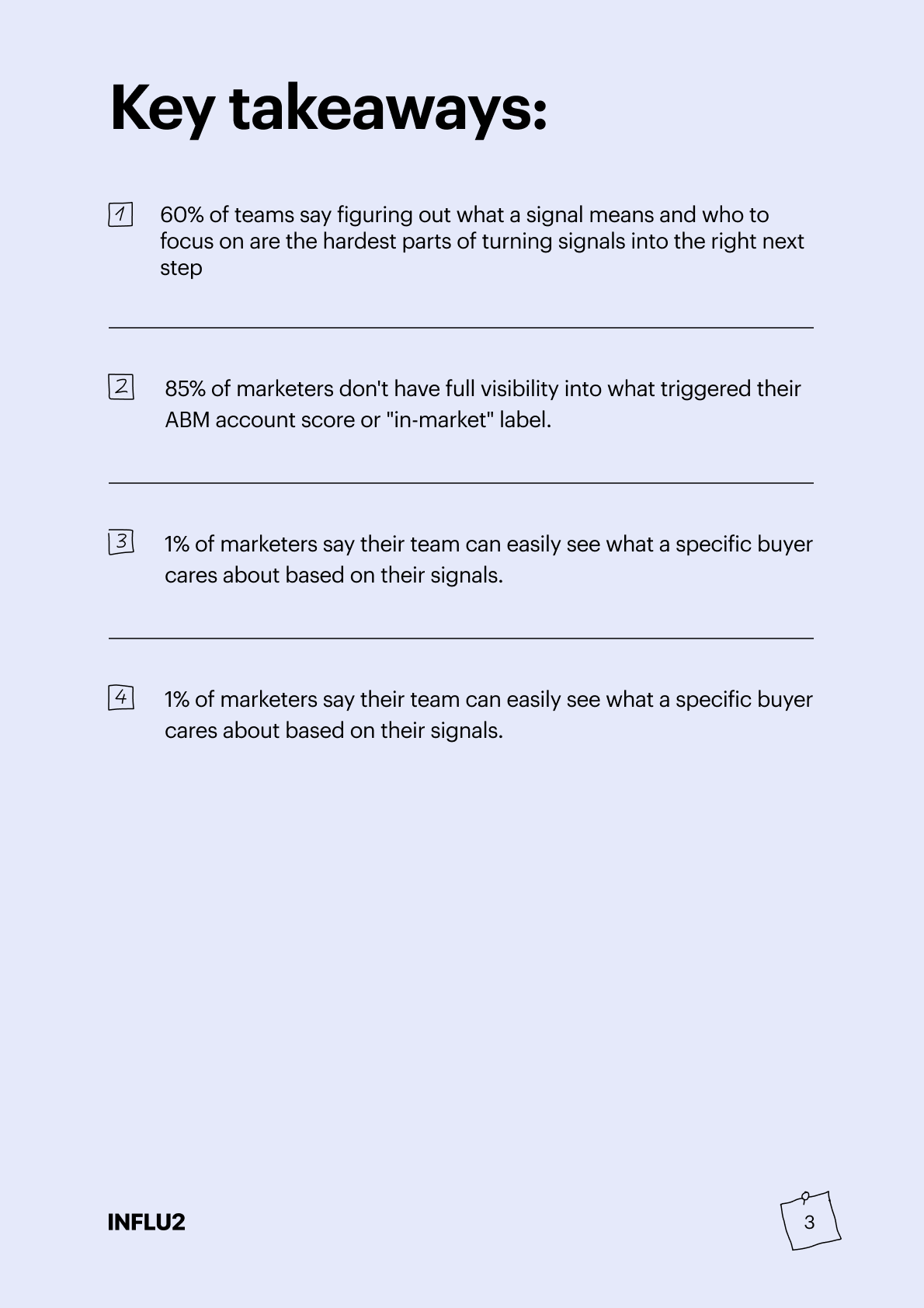
Key takeaways:

60%
of teams say figuring out what a signal means and who to focus on are the hardest parts of turning signals into the right next step.


85%
of marketers don't have full visibility into what triggered their ABM account score or "in-market" label.

1%
of marketers say their team can easily see what a specific buyer cares about based on their signals.

62%
say they need a better understanding of what their signals mean AND the ability to act on them faster.
Orchestration is only as good as the data it runs on. When the starting point is an account-level signal, every sales sequence, ad, and campaign that follows is missing the two things that determine the next best action: who and why.
Confidence in account-level signals is low
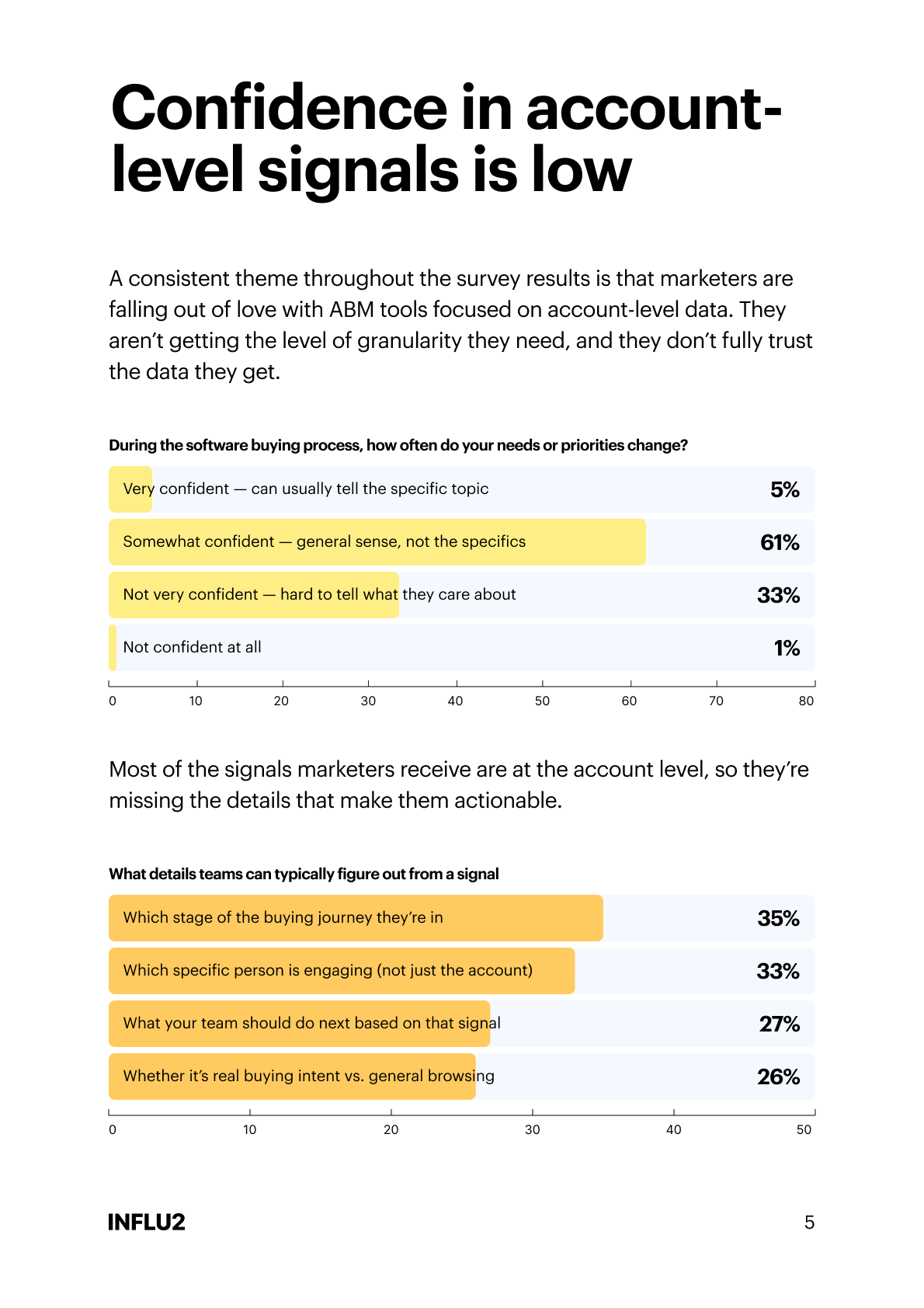
A consistent theme throughout the survey results is that marketers are falling out of love with ABM tools focused on account-level data. They aren’t getting the level of granularity they need, and they don’t fully trust the data they get.
When an intent signal arrives, how confident are you that you know what the buyer is actually interested in?


5%
Very confident — can usually tell the specific topic


61%
Somewhat confident — general sense, not the specifics


33%
Not very confident — hard to tell what they care about


1%
Not confident at all


Most of the signals marketers receive are at the account level, so they’re missing the details that make them actionable.
What details teams can typically figure out from a signal


35%
Which stage of the buying journey they’re in


33%
Which specific person is engaging (not just the account)


26%
Whether it’s real buying intent vs. general browsing


27%
What your team should do next based on that signal


In many cases, the inability to tie signals to a specific person or topic of interest doesn’t stop teams from acting. It just means they act on incomplete information, which leads to wasted resources and generic follow-up.
Contact-level ABM tools can give teams the details that legacy tools lack by putting a name to each signal. But technology is just part of the solution. As Emily Yorke-Goldney, Global ABM Director at Clarify explained, making sense of signals also requires Sales and Marketing to work together.
“The real challenge is knowing which signals indicate genuine buying momentum versus passive activity. But this also can’t sit with Marketing alone. The strongest signal interpretation happens when Sales and Marketing work in tandem, combining engagement data with frontline account insight, relationship context, and deal progression visibility. Without that alignment, teams risk prioritizing noise over opportunities that are genuinely more likely to close.”
— Emily Yorke-Goldney,
Global ABM Director at Clarify
Fragmented signals cause fragmented orchestration
On average, B2B marketing teams work with five signal sources, the most common of which are CRM activity, content engagement, website visits, ad engagement, and third-party intent data. But they’re struggling to connect them all into a clear picture of what one specific buyer wants.
How easy is it to piece signals from multiple channels into a clear picture of one person?


1%
Easy — clear view across channels


44%
Somewhat easy — can connect some dots, but not all


45%
Difficult — signals live in different tools and are hard to connect


11%
Very difficult — mostly look at signals one channel at a time
When signals live in silos, teams end up treating each one as an isolated incident rather than part of a person's entire buying journey. And without contact-level data, orchestration defaults to account-level averages because that's the only layer where the data connects.
To better understand how signals fit into one picture, Anda Stafa, Digital Marketing Manager at Archipelago, suggests stacking signals across channels.
“When you’re working with a defined set of targets, most signals matter, but a single engagement or low-intent signal, like an email open or homepage visit, rarely tells the full story. Teams need to look for signal stacking across channels to respond with timely, relevant messaging.”
— Anda Stafa,
Digital Marketing Manager at Archipelago
Influ2 makes the process easier by automatically guiding buyers forward and adapting every touchpoint across channels as their behavior changes.
Intent scores are black boxes, and teams know it
ABM platforms aggregate individual browsing behavior into an account-level score. An account gets flagged as "high intent" or "in-market," with little to no transparency into the specific people, topics, and actions behind it.
When your ABM or intent tool flags an account as 'high intent,' how clear is it what that's based on?


60%
Somewhat clear — see some inputs, but not the full picture


25%
Not clear — mostly just see the score or label


8%
We don’t use scoring or labels like this


7%
Very clear — can see the specific actions behind it
The lack of clarity has led teams to stop reviewing signals as often as they should, because there isn't enough context to justify the effort.
Before acting on a signal, how often does your team look at the actual behavior behind it?


Always
9%


Often
25%


Sometimes
46%


Rarely
20%


Never
1%

When your team doesn’t dig into the behavior behind a signal, what’s usually the reason?


Too many signals to review one by one
35%


The signals don’t give enough context to make it worthwhile
31%


We don’t have access to that level of detail
17%


Speed matters more — we need to act fast
10%


This doesn’t apply — we almost always review the details
6%
Understanding why your ABM tool says an account is in-market shouldn’t feel like solving a murder mystery. But too often it does, and as Jerry Henry, Sr. Marketing Manager at Remarcable told us, black-box account scores can shift the way GTM teams operate.
“When marketers don’t have visibility into what’s actually driving an ABM score or ‘in-market’ label, it directly impacts confidence in how accounts are prioritized and where teams spend time and budget.”
— Jerry Henry,
Sr. Marketing Manager at Remarcable
The hardest part of acting on signals is figuring out what they mean
Low confidence, fragmented sources, and black-box scores all funnel into the same moment: a signal arrives, and teams aren't sure what it means.
What's the hardest part of acting on a signal?


41%
Figuring out what the signal actually means


19%
Knowing which person to focus on

18%
Getting sales and marketing on the same page


12%
Acting fast enough

11%
Deciding what action to take
When you combine "figuring out what it means" with "knowing which person to focus on," 60% of respondents are pointing at the same underlying problem: a lack of contact-level context.
Gal Fontyn, SVP of Marketing at WalkMe, told us where this problem stems from.
“Most teams are stuck debating what their signals mean because they’re capturing whatever their vendors hand them instead of manufacturing the signals they actually need. When you design intent triggers around specific buying behaviors, ‘what does this mean?’ stops being a question - you already built the answer in.”
— Gal Fontyn,
SVP of Marketing at WalkMe
When signals tell you who and why, orchestration stops being a guess
Signal volume isn't the bottleneck anymore. For most marketers, it’s what signals actually tell them and how fast they can act on them.
61% of marketers say they need a better understanding of what their signals mean and the ability to act on them faster
Giving GTM teams more context for their signals would fundamentally change their ability to orchestrate effectively.
If you could see what topic a specific buyer cares about, based on what they click, read, search, and engage with across channels — what would that unlock?


76%
Trigger the right sales sequence based on their interest


72%
Prioritize outreach to the right people, not just the right accounts


66%
Get sales and marketing aligned on who to go after and why

60%
Serve more relevant ads to that person


58%
Send targeted emails matched to what they’re researching


55%
Reduce wasted follow-ups and false positives
Every one of those is an orchestration move. They only work when the underlying signal is tied to a specific person and topic.
Put your signals in context and let orchestration run on it
Software shouldn’t limit your ABM program. But according to the data, this is often the case. Legacy ABM tools force teams to operate at the account level rather than where B2B decisions actually happen—at the contact level.
The brands that succeed moving forward will be the ones that orchestrate around individual behavior, not account-level rollups.
Influ2 is the contact-level ABM platform built to do exactly that, and has helped GTM teams boost pipeline conversions by up to 2.18x.
Want to learn more?
Influ2 Report
Lost in Translation: The Signal Gap Breaking GTM Orchestration

60% of marketers struggle to answer two questions before they can act on a signal: who’s it from, and what does it mean? Without those answers, orchestration runs on account averages and guesswork instead of buyer context.
We surveyed 101 senior-level marketers and interviewed experts from leading B2B brands to understand what’s stopping teams from turning signals into well-orchestrated action.
This report shares insights into how marketing teams use signals today, where the bottlenecks are, and what better context would change about how they orchestrate.
Download the full report to learn:
- Why having more signals doesn’t produce a clear picture of an individual buyer
- Why the "high-intent" labels most ABM tools surface leave marketers with more questions than answers
- What teams say they'd do differently with contact-level signals
Including insights from
Gal Fontyn
SVP Marketing at WalkMe
Jerry Henry
Sr. Marketing Manager, Field and Partners at Remarcable
Anda Stafa
Digital Marketing Manager at Archipelago
Emily Yorke-Goldney
Global ABM Director at Clarify
Key takeaways:
60%
of teams say figuring out what a signal means and who to focus on are the hardest parts of turning signals into the right next step.

85%
of marketers don't have full visibility into what triggered their ABM account score or "in-market" label.
1%
of marketers say their team can easily see what a specific buyer cares about based on their signals.
62%
say they need a better understanding of what their signals mean AND the ability to act on them faster.
Orchestration is only as good as the data it runs on. When the starting point is an account-level signal, every sales sequence, ad, and campaign that follows is missing the two things that determine the next best action: who and why.
Confidence in account-level signals is low
A consistent theme throughout the survey results is that marketers are falling out of love with ABM tools focused on account-level data. They aren’t getting the level of granularity they need, and they don’t fully trust the data they get.
When an intent signal arrives, how confident are you that you know what the buyer is actually interested in?


5%
Very confident — can usually tell the specific topic


61%
Somewhat confident — general sense, not the specifics


33%
Not very confident — hard to tell what they care about


1%
Not confident at all


Most of the signals marketers receive are at the account level, so they’re missing the details that make them actionable.
What details teams can typically figure out from a signal


35%
Which stage of the buying journey they’re in


33%
Which specific person is engaging (not just the account)


26%
Whether it’s real buying intent vs. general browsing


27%
What your team should do next based on that signal

In many cases, the inability to tie signals to a specific person or topic of interest doesn’t stop teams from acting. It just means they act on incomplete information, which leads to wasted resources and generic follow-up.
Contact-level ABM tools can give teams the details that legacy tools lack by putting a name to each signal. But technology is just part of the solution. As Emily Yorke-Goldney, Global ABM Director at Clarify explained, making sense of signals also requires Sales and Marketing to work together.
“The real challenge is knowing which signals indicate genuine buying momentum versus passive activity. But this also can’t sit with Marketing alone. The strongest signal interpretation happens when Sales and Marketing work in tandem, combining engagement data with frontline account insight, relationship context, and deal progression visibility. Without that alignment, teams risk prioritizing noise over opportunities that are genuinely more likely to close.”
— Emily Yorke-Goldney,
Global ABM Director at Clarify
Fragmented signals cause fragmented orchestration
On average, B2B marketing teams work with five signal sources, the most common of which are CRM activity, content engagement, website visits, ad engagement, and third-party intent data. But they’re struggling to connect them all into a clear picture of what one specific buyer wants.
How easy is it to piece signals from multiple channels into a clear picture of one person?


1%
Easy — clear view across channels


44%
Somewhat easy — can connect some dots, but not all


45%
Difficult — signals live in different tools and are hard to connect


11%
Very difficult — mostly look at signals one channel at a time
When signals live in silos, teams end up treating each one as an isolated incident rather than part of a person's entire buying journey. And without contact-level data, orchestration defaults to account-level averages because that's the only layer where the data connects.
To better understand how signals fit into one picture, Anda Stafa, Digital Marketing Manager at Archipelago, suggests stacking signals across channels.
“When you’re working with a defined set of targets, most signals matter, but a single engagement or low-intent signal, like an email open or homepage visit, rarely tells the full story. Teams need to look for signal stacking across channels to respond with timely, relevant messaging.”
— Anda Stafa,
Digital Marketing Manager at Archipelago
Influ2 makes the process easier by automatically guiding buyers forward and adapting every touchpoint across channels as their behavior changes.
Intent scores are black boxes, and teams know it
ABM platforms aggregate individual browsing behavior into an account-level score. An account gets flagged as "high intent" or "in-market," with little to no transparency into the specific people, topics, and actions behind it.
When your ABM or intent tool flags an account as 'high intent,' how clear is it what that's based on?


60%
Somewhat clear — see some inputs, but not the full picture


25%
Not clear — mostly just see the score or label


8%
We don’t use scoring or labels like this


7%
Very clear — can see the specific actions behind it
The lack of clarity has led teams to stop reviewing signals as often as they should, because there isn't enough context to justify the effort.
Before acting on a signal, how often does your team look at the actual behavior behind it?

Always
9%

Often
25%

Sometimes
46%
Rarely
20%

Never
1%

When your team doesn’t dig into the behavior behind a signal, what’s usually the reason?

Too many signals to review one by one
35%

The signals don’t give enough context to make it worthwhile
31%

We don’t have access to that level of detail
17%

Speed matters more — we need to act fast
10%

This doesn’t apply — we almost always review the details
6%
Understanding why your ABM tool says an account is in-market shouldn’t feel like solving a murder mystery. But too often it does, and as Jerry Henry, Sr. Marketing Manager at Remarcable told us, black-box account scores can shift the way GTM teams operate.
“When marketers don’t have visibility into what’s actually driving an ABM score or ‘in-market’ label, it directly impacts confidence in how accounts are prioritized and where teams spend time and budget.”
— Jerry Henry,
Sr. Marketing Manager at Remarcable
The hardest part of acting on signals is figuring out what they mean
Low confidence, fragmented sources, and black-box scores all funnel into the same moment: a signal arrives, and teams aren't sure what it means.
What's the hardest part of acting on a signal?


41%
Figuring out what the signal actually means


19%
Knowing which person to focus on


18%
Getting sales and marketing on the same page


12%
Acting fast enough

11%
Deciding what action to take
When you combine "figuring out what it means" with "knowing which person to focus on," 60% of respondents are pointing at the same underlying problem: a lack of contact-level context.
Gal Fontyn, SVP of Marketing at WalkMe, told us where this problem stems from.
“Most teams are stuck debating what their signals mean because they’re capturing whatever their vendors hand them instead of manufacturing the signals they actually need. When you design intent triggers around specific buying behaviors, ‘what does this mean?’ stops being a question - you already built the answer in.”
— Gal Fontyn,
SVP of Marketing at WalkMe
When signals tell you who and why, orchestration stops being a guess
Signal volume isn't the bottleneck anymore. For most marketers, it’s what signals actually tell them and how fast they can act on them.
61% of marketers say they need a better understanding of what their signals mean and the ability to act on them faster
Giving GTM teams more context for their signals would fundamentally change their ability to orchestrate effectively.
If you could see what topic a specific buyer cares about, based on what they click, read, search, and engage with across channels — what would that unlock?


76%
Trigger the right sales sequence based on their interest

72%
Prioritize outreach to the right people, not just the right accounts


66%
Get sales and marketing aligned on who to go after and why

60%
Serve more relevant ads to that person


58%
Send targeted emails matched to what they’re researching

55%
Reduce wasted follow-ups and false positives
Every one of those is an orchestration move. They only work when the underlying signal is tied to a specific person and topic.
Put your signals in context and let orchestration run on it
Software shouldn’t limit your ABM program. But according to the data, this is often the case. Legacy ABM tools force teams to operate at the account level rather than where B2B decisions actually happen—at the contact level.
The brands that succeed moving forward will be the ones that orchestrate around individual behavior, not account-level rollups.
Influ2 is the contact-level ABM platform built to do exactly that, and has helped GTM teams boost pipeline conversions by up to 2.18x.
Want to learn more?
Influ2 Report
Lost in Translation: The Signal Gap Breaking GTM Orchestration
60% of marketers struggle to answer two questions before they can act on a signal: who’s it from, and what does it mean? Without those answers, orchestration runs on account averages and guesswork instead of buyer context.


We surveyed 101 senior-level marketers and interviewed experts from leading B2B brands to understand what’s stopping teams from turning signals into well-orchestrated action.
This report shares insights into how marketing teams use signals today, where the bottlenecks are, and what better context would change about how they orchestrate.
Download the full report to learn:
- Why having more signals doesn’t produce a clear picture of an individual buyer
- Why the "high-intent" labels most ABM tools surface leave marketers with more questions than answers
- What teams say they'd do differently with contact-level signals
Including insights from
Gal Fontyn
SVP Marketing at WalkMe
Jerry Henry
Sr. Marketing Manager, Field and Partners at Remarcable
Anda Stafa
Digital Marketing Manager at Archipelago
Emily
Yorke-Goldney
Global ABM Director at Clarify
Key takeaways:
60%
of teams say figuring out what a signal means and who to focus on are the hardest parts of turning signals into the right next step.

85%
of marketers don't have full visibility into what triggered their ABM account score or "in-market" label.
1%
of marketers say their team can easily see what a specific buyer cares about based on their signals.
62%
say they need a better understanding of what their signals mean AND the ability to act on them faster.
Orchestration is only as good as the data it runs on. When the starting point is an account-level signal, every sales sequence, ad, and campaign that follows is missing the two things that determine the next best action: who and why.
Confidence in account-level signals is low
A consistent theme throughout the survey results is that marketers are falling out of love with ABM tools focused on account-level data. They aren’t getting the level of granularity they need, and they don’t fully trust the data they get.

When an intent signal arrives, how confident are you that you know what the buyer is actually interested in?


Very confident — can usually tell the specific topic
5%


Somewhat confident — general sense, not the specifics
61%


Not very confident — hard to tell what they care about
33%


Not confident at all
1%


Most of the signals marketers receive are at the account level, so they’re missing the details that make them actionable.
What details teams can typically figure out from a signal


Which stage of the buying journey they’re in
35%


Which specific person is engaging (not just the account)
33%


Whether it’s real buying intent vs. general browsing
26%


What your team should do next based on that signal
27%

In many cases, the inability to tie signals to a specific person or topic of interest doesn’t stop teams from acting. It just means they act on incomplete information, which leads to wasted resources and generic follow-up.
Contact-level ABM tools can give teams the details that legacy tools lack by putting a name to each signal. But technology is just part of the solution. As Emily Yorke-Goldney, Global ABM Director at Clarify explained, making sense of signals also requires Sales and Marketing to work together.
“The real challenge is knowing which signals indicate genuine buying momentum versus passive activity. But this also can’t sit with Marketing alone. The strongest signal interpretation happens when Sales and Marketing work in tandem, combining engagement data with frontline account insight, relationship context, and deal progression visibility. Without that alignment, teams risk prioritizing noise over opportunities that are genuinely more likely to close.”
— Emily Yorke-Goldney,
Global ABM Director at Clarify
Fragmented signals cause fragmented orchestration
On average, B2B marketing teams work with five signal sources, the most common of which are CRM activity, content engagement, website visits, ad engagement, and third-party intent data. But they’re struggling to connect them all into a clear picture of what one specific buyer wants.
How easy is it to piece signals from multiple channels into a clear picture of one person?

Easy — clear view across channels
1%


Somewhat easy — can connect some dots, but not all
44%

Difficult — signals live in different tools and are hard to connect
45%


Very difficult — mostly look at signals one channel at a time
11%
When signals live in silos, teams end up treating each one as an isolated incident rather than part of a person's entire buying journey. And without contact-level data, orchestration defaults to account-level averages because that's the only layer where the data connects.
To better understand how signals fit into one picture, Anda Stafa, Digital Marketing Manager at Archipelago, suggests stacking signals across channels.
“When you’re working with a defined set of targets, most signals matter, but a single engagement or low-intent signal, like an email open or homepage visit, rarely tells the full story. Teams need to look for signal stacking across channels to respond with timely, relevant messaging.”
— Anda Stafa,
Digital Marketing Manager at Archipelago
Influ2 makes the process easier by automatically guiding buyers forward and adapting every touchpoint across channels as their behavior changes.
Intent scores are black boxes, and teams know it
ABM platforms aggregate individual browsing behavior into an account-level score. An account gets flagged as "high intent" or "in-market," with little to no transparency into the specific people, topics, and actions behind it.
When your ABM or intent tool flags an account as 'high intent,' how clear is it what that's based on?

Somewhat clear — see some inputs, but not the full picture
60%


Not clear — mostly just see the score or label
25%


We don’t use scoring or labels like this
8%


Very clear — can see the specific actions behind it
7%
The lack of clarity has led teams to stop reviewing signals as often as they should, because there isn't enough context to justify the effort.
Before acting on a signal, how often does your team look at the actual behavior behind it?


Always
9%


Often
25%


Sometimes
46%

Rarely
20%


Never
1%

When your team doesn’t dig into the behavior behind a signal, what’s usually the reason?


Too many signals to review one by one
35%


The signals don’t give enough context to make it worthwhile
31%


We don’t have access to that level of detail
17%


Speed matters more — we need to act fast
10%


This doesn’t apply — we almost always review the details
6%
Understanding why your ABM tool says an account is in-market shouldn’t feel like solving a murder mystery. But too often it does, and as Jerry Henry, Sr. Marketing Manager at Remarcable told us, black-box account scores can shift the way GTM teams operate.
“When marketers don’t have visibility into what’s actually driving an ABM score or ‘in-market’ label, it directly impacts confidence in how accounts are prioritized and where teams spend time and budget.”
— Jerry Henry,
Sr. Marketing Manager at Remarcable
The hardest part of acting on signals is figuring out what they mean
Low confidence, fragmented sources, and black-box scores all funnel into the same moment: a signal arrives, and teams aren't sure what it means.
What's the hardest part of acting on a signal?


Figuring out what the signal actually means
41%

Knowing which person to focus on
19%


Getting sales and marketing on the same page
18%


Acting fast enough
12%

Deciding what action to take
11%
When you combine "figuring out what it means" with "knowing which person to focus on," 60% of respondents are pointing at the same underlying problem: a lack of contact-level context.
Gal Fontyn, SVP of Marketing at WalkMe, told us where this problem stems from.
“Most teams are stuck debating what their signals mean because they’re capturing whatever their vendors hand them instead of manufacturing the signals they actually need. When you design intent triggers around specific buying behaviors, ‘what does this mean?’ stops being a question - you already built the answer in.”
— Gal Fontyn,
SVP of Marketing at WalkMe
When signals tell you who and why, orchestration stops being a guess
Signal volume isn't the bottleneck anymore. For most marketers, it’s what signals actually tell them and how fast they can act on them.
61% of marketers say they need a better understanding of what their signals mean and the ability to act on them faster
Giving GTM teams more context for their signals would fundamentally change their ability to orchestrate effectively.

If you could see what topic a specific buyer cares about, based on what they click, read, search, and engage with across channels — what would that unlock?


Trigger the right sales sequence based on their interest
76%
Prioritize outreach to the right people, not just the right accounts
72%


Get sales and marketing aligned on who to go after and why
66%

Serve more relevant ads to that person
60%

Send targeted emails matched to what they’re researching
58%


Reduce wasted follow-ups and false positives
55%
Every one of those is an orchestration move. They only work when the underlying signal is tied to a specific person and topic.
Put your signals in context and let orchestration run on it
Software shouldn’t limit your ABM program. But according to the data, this is often the case. Legacy ABM tools force teams to operate at the account level rather than where B2B decisions actually happen—at the contact level.
The brands that succeed moving forward will be the ones that orchestrate around individual behavior, not account-level rollups.
Influ2 is the contact-level ABM platform built to do exactly that, and has helped GTM teams boost pipeline conversions by up to 2.18x.
Want to learn more?