


Influ2 Report
ABM that
starts with
peopleABM that starts
with people
How contact-level ABM
orchestration
boosts pipeline
conversion by up to 2.18x
How contact-level ABM orchestration boosts pipeline conversion by up to 2.18x
[ Get the report ]
ABM that starts with people
[ Get the report ]
How contact-level ABM orchestration boosts pipeline conversion by up to 2.18x
[ Get the report ]
ABM that starts with people
[ Get the report ]
ABM was always meant to be personal. But most programs are still orchestrated at the account level—where real buyer behavior gets averaged out, signals show up late, and “personalization” turns into a best guess.
This report shows what changes when orchestration starts with the individual.
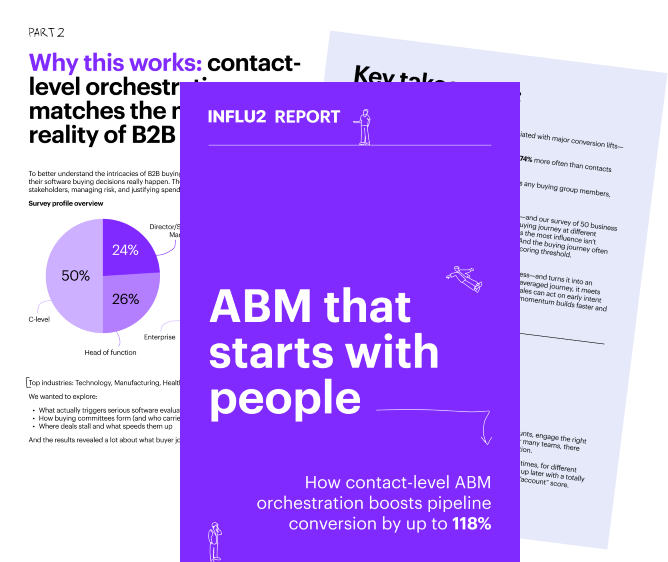
Download the full report to learn about:
- Why real B2B buying journeys are messier than most marketers assume
- How contact-level ABM orchestration helps teams stay relevant in that mess
- Why this approach is linked to stronger meeting and pipeline conversion
Key takeaways:

Contact-level ABM orchestration is associated with major pipeline conversion lifts— up to 2.18x

Conversion to booked meetings is 1.74x higher for engaged contacts.
Pipeline conversion is 2.18x higher for buying groups with at least 1 ad click.

B2B buying journeys start early, shift often, and involve conflicting priorities
B2B buying is messy. Different stakeholders enter the buying journey at different moments, with different priorities. The person who has the most influence isn't always the person who raises the biggest objections. And the buying journey often starts long before an account crosses an “in-market” scoring threshold.

Contact-level ABM orchestration matches the messy reality of B2B buying
Contact-level ABM orchestration is built for that messiness—and turns it into an advantage. Instead of forcing the account through one averaged journey, it meets each buyer where they are, based on real signals. And Sales can act on early intent instead of waiting for an account score to catch up.
What happens when ABM orchestration is done at the contact level?
Conversion to booked meetings increases
by up to 1.74x for individual buyers
Targets repeatedly showed a 1.29x uplift in booked meeting conversion compared to cold outreach alone.
And when someone actively engaged, the lift was even stronger: booked meeting conversion increased by up to 1.74x.
This uplift is possible because you're reaching more of the right people with messaging that matches what they care about—giving Sales a strong assist. Outreach stops feeling “cold” because buyers already recognize what you do.
And in many cases, you're not just capturing intent—you're shaping it earlier.
Conversion to pipeline increases by up to 2.18x
for accounts with engagement across the buying group
When buying group members had consistent ad exposure (15+ impressions), pipeline conversion was 1.66x higher than the cold pipeline baseline.
And when they showed active engagement (at least one click), pipeline conversion was 2.18x higher.
So what do these high-performing teams have in common? They serve messaging that matches each buyer's context, spot early contact-level signals, and align Sales follow-up to the specific people showing interest.
Why this works: contact-level orchestration matches the messy reality of B2B buying
B2B buying journeys are messy by nature. Priorities shift, stakeholders change their minds, budget approvals drag, and momentum can disappear fast. People behave like people—even in B2B deals.
According to 50 leaders from mid-market and enterprise companies, this is how a buying process looks like for them:
1. Senior leaders may lead B2B buying decisions (32%), but IT and Security are the most likely to block them (38%)
Whose opinion tends to carry the most weight?
Who usually raises the biggest objections in a purchase?
So here's the wildcard: even though IT/security only accounted for 10% of “most weight,” they were cited as the biggest source of objections in 38% of cases.
This is a very showing example of why B2B buying decisions are messy. You might be aligned with a few stakeholders and still lose because someone you barely engaged—security, finance, legal, whoever—derails it late.
Which is exactly why account-level orchestration breaks down. When you throw everyone into the same journey, you're forced into average messaging.
2. 66% of B2B buyers either occasionally or frequently change their priorities during the buying process
Even after a buying process starts, needs can change. Budget pressure, internal changes, and competing priorities can all reshape the decision. That's the reality. And it's deeply human.
Traditional ABM often assumes that once people are “in a deal,” they behave predictably. They don't. So you need an ABM approach that accounts for the human part.
During the software buying process, how often do your needs or priorities change?

3. The buyer journey starts when a current tool no longer meets a buyer's needs—not when an account hits a scoring threshold
A buying journey does not begin when an account score crosses a threshold. By then, some stakeholders may already be researching options, forming opinions, and narrowing the shortlist.
What triggers a serious software evaluation?
How many vendors are you usually evaluating at the same time?
If teams wait for account-level confirmation, they often miss the most influential window. Contact-level orchestration helps you show up earlier—while buyers are still shaping their preferences.
What to take from all this
People are people. They forget to reply. They change priorities mid-deal. They enter the journey at different times and for different reasons.
That’s why ABM orchestration should mirror each buyer’s context. Don’t wait for an account score to climb. Every meaningful signal is a chance to connect. That’s how you get a 2.18x pipeline conversion increase.
Ready to orchestrate ABM around real buyers, not account averages?